Peter Canavese
2012-01-16 20:19:00 UTC
<em>Proof</em> plays cleverly with the arcane mysteries of game theory, and if it's only a game, happily, it's one worthy of exhibition.


Some things cannot be proven or disproven—trust, faith, love, sanity, and the meaning of existence. This oh-so-popular postmodern theme spawned the Pulitzer-Prize-winning play of 2001, David Auburn's Proof (also, in its way, this year's Pulitzer winner for drama, John Patrick Shanley's Doubt). Auburn, in collaboration with Rebecca Miller, has adapted Proof for the screen, and if the just-so package wrapped by Miramax's Harvey Weinstein (and reuniting Shakespeare in Love's director John Madden and star Gwyneth Paltrow) reveals less than its trimmings promise, it's still a thoughtful and useful gift.
Madden and Paltrow also collaborated on a London stage production of Proof, and their confidence brings clarity to the material while draining it of some of its spontaneity. Paltrow plays Catherine, devoted daughter to a genius mathematician named Robert (Anthony Hopkins). When Robert's brilliance dulls with the advance of age, mental instability emerges and effectively ends his academic career at the University of Chicago. Catherine puts her life on hold to care for her father and, day by day, share his hope of reclaiming his once-great mind.
Robert's story unfolds in flashback scenes, underscoring the looming shadow cast by genius and familial authority. At the film's outset, Catherine and her sister Claire (Hope Davis) must deal with the practical and emotional fallout of his recent death. The long-distant Claire sees Robert's death as an opportunity to end a messy chapter of her family history and forestall a new and equally tragic chapter from beginning. Claire believes that Catherine shares their father's potential for genius and insanity. In a gesture of newfound responsibility—and assertion of control—the insufferable Claire insists on relocating her sister from the haunted university home to a protective environment.
Naturally, Claire's plan is cause for considerable tension, in part because of Catherine's personal incompatibility with her fussy sister and in part because of Catherine's considerable self-doubt. As Catherine faces the ever-more-likely prospect of being locked outside of the world she shared with her father and the world she desires for herself, grief begins to look a lot like insanity. Ground zero is the arcane and mysterious field of mathematics. In Robert's declining years, he enjoys a period of resurgence and believes he's on the cusp of a major breakthrough; meanwhile, Catherine explores her own potential as a graduate student in mathematics. Certainly, she is her father's daughter, but will she reveal his genius, his insanity, or both?
A fourth character shows a vested interest in the answer to that question. Hal (Jake Gyllenhaal), a doctoral student once under Robert's mentorship, reveals two not unrelated desires upon his death: to fulfill his long-held longing for Catherine and to plumb Robert's ostensibly crazed scribblings for signs of brilliance. As the dust clears, a key piece of evidence appears: a mathematical proof that, should it check out, will prove to be a major advance. Catherine claims to have authored the proof; Hal insists it could only be the work of her father.
To varying degrees, the four central characters fear the infinite cold of death (literal and metaphorical: "the downward slope" that follows a life's peak of productivity) and the prospect of madness. The cast acquits itself admirably, with Paltrow and Hopkins at the fore—the former enjoying a well-rounded character and the latter responding to juicy theatrics. Davis earnestly does her best with her brittle role; Gyllenhaal's equivocal lover, puppyish and ambitious in equal measure, never fully coalesces, but the script and director share responsibility. In the central role, Paltrow anchors the film with convincingly wound-up anxiety and guilt, as well as a crucial measure of ambiguity: while it's easy to read the film's conclusion about her character's actions in one way, the filmmakers subtly lay in the ongoing possibility that the opposite is true (follow the key).
Auburn's story sparks intriguing considerations about greatness—so powerfully seductive and so terribly elusive—the far edges of reason that yield to genius and madness, and the impossibility of proof (and, therefore, the arguable necessity of faith). The screenplay's complex but never confusing structure intensifies interest and holds at bay the inevitable disapointment of resolution. From the first scene to the last, this phase of Catherine's life is a proof: she reviews it for verification, looks for a more direct path, a "better" way, but concludes that it is what it is. Proof plays cleverly with the arcane mysteries of game theory, and if it's only a game, happily, it's one worthy of exhibition. In the end, Auburn and Miller invite reflection on an epochal question: do our lives add up to something?

|
|
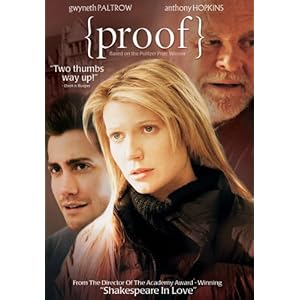 |
Echo Bridge Home Entertainment has an iffy track record when it comes to presenting films in the proper aspect ratio and in hi-def transfers that otherwise represent a significant improvement over their standard-def equivalents. Slowly but surely, they're working to rehabilitate that image, and their release of Proof—a title in their Miramax Classics line—is definitely a step in the right direction. Echo Bridge still has issues with subtitles and/or closed captioning (shamefully, there are none), as well as listing proper specs on packaging and on their website, leading to confusion for consumers pondering pre-orders. For instance, while the packaging lists only Dolby Digital 5.1 audio, implying a lossy presentation, the disc actually includes two more lossless audio options, in DTS-HD Master Audio 5.1 and LPCM 2.0.
That's plenty of audio muscle for a drama of this type, and the DTS mix affords fine quality in terms of clear dialogue, pleasing music, and some humble ambience. The video comes in the proper aspect ratio of 2.35:1, and does represent a noticeable step up from the grainy DVD. The 2004 film may look its age, but there's nothing wrong with that: the slightly soft feel recalls Proof's natural theatrical appearance, and no edge enhancement caught my eye (just one instance of mild aliasing on the grill of a city bus). While it's probable that the image could be a bit more finely resolved, we can be grateful that this not especially popular title has gotten a significant A/V upgrade, and at a no-brainer budget price.
Of course, to some degree, you get what you pay for, and Echo Bridge hasn't ponied up for the rights to any of the bonus features. So Proof fans, be warned: hold on to your DVDs, as you won't find the John Madden commentary, featurette or deleted scenes found on the original release. While understandable, that's also a disappointment.
|