

 RSS or
 Email.

Sponsored Links
Related Reviews
Ricky Gervais
-
The Invention of Lying (2009)

-
Cemetery Junction (2010)


-
Louie: The Complete First Season (2011)

-
Muppets Most Wanted (2014)

Greg Kinnear
-
Baby Mama (2008)
-
Fast Food Nation (2006)
-
Invincible (2006)
-
Little Miss Sunshine (2006)
-
The Matador (2005)
-
Bad News Bears (2005)
-
Robots (2005)
-
Stuck on You (2003)

-
We Were Soldiers (2002)
-
Flash of Genius (2008)
-
Green Zone (2010)
-
The Last Song (2010)

-
You've Got Mail (1998)
-
Thin Ice (a.k.a. The Convincer) (2011)
-
Modern Family: The Complete Third Season (2009)
Alan Ruck
Téa Leoni
David Koepp


Ghost Town
(2008)

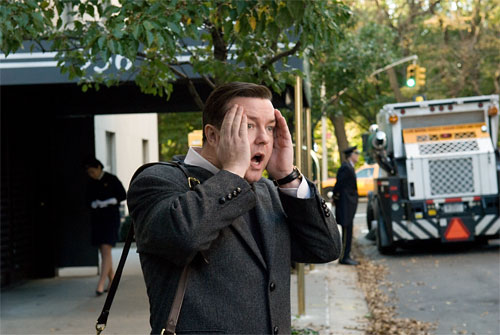
On paper, David Koepp's Ghost Town sounds like a hackneyed rehash of a premise that's been, well, done to death. But ask any comedian (as did the documentary The Aristocrats) and they'll tell you: the power of the joke is in the telling. And where it counts, Ghost Town is very well told, indeed: the comic voice of Ricky Gervais comes through loud and clear, and Koepp's vision of a classical Hollywood comedy creates a confluence not only of great performers but of considerable wit and heart.
Through misuse, "heart" has become somewhat of a dirty word when it comes to Hollywood comedies, but Koepp (who shares screenplay credit with John Kamps) cultivates sentiment that's well-earned and sincere, not canned. On the way there, Ghost Town is as funny as any movie to come out this year. At its essence, Ghost Town is Topper multiplied, with Gervais' misanthropic dentist Bertram Pincus seeing dead people all over Manhattan following a botched medical procedure (some of the film's funniest scenes involve the brilliant Kristin Wiig as a purposefully inarticulate surgeon and Michael-Leon Wooley as her in-house legal counsel). Greg Kinnear plays Frank Herlihy, an urbane ghost (he died with his tux on) who remains in limbo due to "unfinished" business with wife Gwen (Téa Leoni). Though Frank was a cad with a girl on the side, he's had time to reflect on the depth of his love for his wife, and fears she'll go through with her plans to marry a human-rights lawyer named Richard (Billy Campbell).
Since Pincus is the only conduit ghosts have with the living world, he becomes a celeb to the lingering dead, and he can't hire security to keep them from hounding (a.k.a. haunting) him. Frank's force of personality puts him front and center with Pincus, who Frank wants to use as spoiler for Gwen and Richard's engagement. As living nightmares go, it's a perfect storm for Pincus, who would rather sit at home alone with a crossword than have to suffer through a conversation with anyone ("It's not so much the crowds as the individuals in the crowds," he explains). Now he has demanding ghosts huddling 'round his bed and, worse, feelings stirring up from long-undisturbed depths. The beautiful Gwen—a mummy expert at the Metropolitam Museum—provides a strong incentive for Bertram to get back in the game.
At 102 minutes, Ghost Town doesn't have enough time fully to develop the internal logic of a world of ghosts with no boundaries, but Koepp's approach is smart and literate, from the visual and thematic complements of the mummy trappings to the perfectly judged exchange that ends the picture. The fertile dialogue and humor emerges from strong characters with interesting foibles, performed by actors keen on both comedy and drama. Though they're an unlikely pair, Leoni and Gervais develop a credible chemistry that follows a funny and involving arc from her initial appraisal of him (well deserved) as "a little bit of a jerk." Fast-talking Kinnear uses his quirky expressiveness to full effect and downshifts as required into just the right tone of wistfulness. (Kudos also to Aasif Mandvi as Pincus' drily reactive workmate and an ensemble of ghosts led by Dana Ivey and Alan Ruck.)
Above all, Gervais once more proves himself a major talent. Without him, it's unlikely Ghost Town would pass the funny test. With him, the film's conversational rhythms are endlessly surprising, as Pincus falls into awkward conversational traps, makes misjudged attempts at being sociable, and generally despairs over the stupidity of his fate. Koepp's comic fantasy—of death and what happens next, of first impressions and getting deeper, of second chances—locates its own distinctive way of developing the age old carpe diem theme. As Gwen eloquently puts it, "What happens matters. Maybe only to us, but it matters." If that's not a word to the wise, it's at least a word to the selfish and cold. And any movie that can send out that word while being consistently funny deserves a wide audience.


 Permalink
 |
|
 |
Paramount brings Ghost Town back to life on Blu-ray and DVD in a modest but satisfying special edition. On Blu-ray, the film retains a healthy (and therefore not distracting) level of film grain to complement a clean and detailed image that nicely highlights the New York City locations. The picture can be a bit contrasty, and as a result of the color scheme seemingly chosen by the filmmaker, the flesh tones sometimes translate oddly (Tea Leoni's "golden" look sometimes makes her face appear yellow, for example). On the whole, it's a fine transfer, and the Dolby TrueHD 5.1 soundtrack is more than up to the task of showcasing the film's dialogue and peppy music (including the Beatles' "I'm Looking Through You").
First among the bonus features is a commentary by writer-director David Koepp and actor Ricky Gervais that the latter apologetically calls "drivel" when he's not not-so-apologetically insulting the listener as someone who needs to "get a life." It's all in keeping with the film's early-going misanthropy and Gervais' general suspicion of all commercial demands. Despite the chatters' cheeky exasperation, there's plenty of fun bits in this commentary, such as a discussion of Gervais' sequel ideas ("Ghost Babies") and a Gervais pitch for an Ironside movie that's so ridiculously funny I hurt myself laughing. Koepp and Gervais discuss their working relationship, ripping off Laurel and Hardy, shooting comedy, employing improv, the Temple of Dendur, and Gervais' ideal and nightmare shooting conditions. Gervais' upcoming directorial debut This Side of the Truth also gets teased a few times as part of an organic dialogue between two directors.
Three HD featurettes round out the special edition. The first, "Making Ghost Town" (22:40), is standard-issue stuff, but still fairly interesting. Many of the film's talents get a chance to comment, you get a bit of clowning from Gervais, and there's some cool behind-the-scenes footage. Participants include Koepp, Gervais, co-screenwriter John Kamps, producer Gavin Polone, Greg Kinnear, Leoni, Kristen Wiig, Billy Campbell, Dana Ivey, executive producer Ezra Swerdlow, costume designer Sarah Edwards, and production designer Howard Cummings. "Ghostly Effects" (2:01) is a brief SFX montage reel showing the development of a few key shots. "Some People Can Do It" (6:21) is the most valuable video-based feature. It's an outtake reel featuring Gervais, and as his fans know, no Gervais release is complete without one.
Ghost Town comes highly recommended as the best comedy film of 2008.
 |
| Review gear: |
Panasonic Viera TC-P55VT30 55" Plasma 1080p 3D HDTV
Oppo BDP-93 Universal Network 3D Blu-ray Disc Player
Denon AVR2112CI Integrated Network A/V Surround Receiver
|
Pioneer SP-BS41-LR Bookshelf Speaker (2)
Pioneer SP-C21 Center Speaker
Pioneer SW-8 Subwoofer
|
|---|