

 RSS or
 Email.

Sponsored Links
Related Reviews
-
The Dark Knight (2008)


-
Batman Begins (2005)
-
Batman: Gotham Knight (2008)

-
Batman (1989)

-
Batman Returns (1992)
-
Batman & Robin (1997)

-
Batman (1966)
-
Batman (1943)

-
Batman and Robin (1949)
-
Batman: Mask of the Phantasm (1993)
-
The Dark Knight Rises (2012)
-
Batman v Superman: Dawn of Justice (2016)
-
The Batman (2022)
Val Kilmer
-
Déjà vu (2006)
-
Kiss Kiss, Bang Bang (2005)
-
Mindhunters (2005)

-
Spartan (2004)
-
Top Gun (1986)
-
True Romance (1993)
-
Heat (1995)
-
Tombstone (1993)
Tommy Lee Jones
-
No Country for Old Men (2007)
-
In the Valley of Elah (2007)
-
The Three Burials of Melquiades Estrada (2005)
-
The Missing (2003)
-
Men in Black II (2002)
-
Men In Black (1997)
-
Natural Born Killers (1994)
-
Lonesome Dove (TV) (1989)
-
Harvard Beats Yale 29-29 (2009)
-
The Company Men (2010)
-
Captain America (2011)
-
Men in Black 3 (2012)
-
U.S. Marshals (1998)
-
Hope Springs (2012)
-
Emperor (2013)
-
Lincoln (2012)
-
Jason Bourne (2016)
Jim Carrey
-
Dr. Seuss' Horton Hears a Who (2008)
-
The Number 23 (2007)

-
The Truman Show (1996)
-
Lemony Snicket's A Series of Unfortunate Events (2004)
-
Eternal Sunshine of the Spotless Mind (2004)
-
Bruce Almighty (2003)
-
The Mask (1994)
-
Dumb and Dumber (1994)
-
Yes Man (2008)
-
Disney's A Christmas Carol (2009)
-
I Love You Phillip Morris (2010)
-
Kick-Ass 2 (2013)
-
Sonic the Hedgehog 2 (2022)
Nicole Kidman
-
The Invasion (2007)
-
Happy Feet (2006)
-
Bewitched (2005)
-
The Interpreter (2005)
-
Dogville (2004)
-
Cold Mountain (2003)
-
The Hours (2002)
-
Eyes Wide Shut (1999)
-
Days of Thunder (1990)
-
Rabbit Hole (2010)
-
Just Go with It (2011)
-
The Paperboy (2012)
-
Stoker (2013)
-
Boy Erased (2018)
Chris O'Donnell
Joel Schumacher


Batman Forever
(1995)

 With The Lost Boys to his credit—and coming off of two solid Hollywood thrillers, The Client and Falling Down—newly adopted director Joel Schumacher gave reason to hope that a Burton-less Batman could still hold interest. But Batman fans smelled a rat as soon as they heard the title of the second Batman sequel: Batman Forever. The fatuousness of that title sums up Schumacher's approach. The director allows his few scrupulous choices to be overwhelmed by garish vaudeville.
Schumacher consciously aligns himself with the camp of William Dozier's 1960's Batman TV series. That show wittily played it straight to generate adult humor while exciting kids' imaginations. Burton's films likewise kept a stiff lower lip, rarely lacking for humor, but honest to a prevailing tonal darkness. Co-producer Tim Burton is present for Batman Forever in name only, as Schumacher overworks dutch and wide angles, and adds nonsensical and tasteless style flourishes like a stupid-looking Batmobile refit.
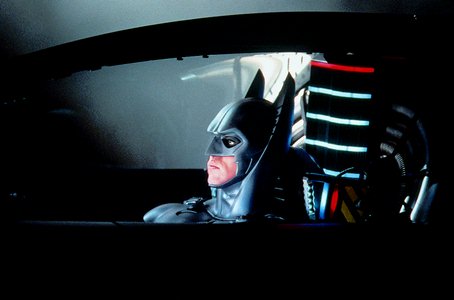
Michael Keaton jumped ship with Burton, so Val Kilmer took over the role of Batman. Kilmer never seems at ease in the role, and turns in an impassive, colorless performance completely at odds with Schumacher's vision. Schumacher famously told Premiere magazine, "Val did me two great favors. When I wanted him to be Batman, he said yes. Then he created a situation which allowed me not to have him play Batman again. They were both happy, happy instances, for which I will always be grateful." It's tempting to view the film's dreamy highlights—stylish origin flashbacks tormenting Batman's alter ego Bruce Wayne—as a concession to Kilmer, who, like many actors, actually wanted to act.
Batman Forever also introduces Robin (Chris O'Donnell), Batman's sometime sidekick. Since his first comic-book appearance in 1940, Robin has mostly been depicted as "the Boy Wonder," but O'Donnell's college-age Dick Grayson retains an authentic origin: orphaned when circus performers "the Flying Graysons," disrupted by criminals, plummet to their deaths. O'Donnell's too old to play this petulant Robin (one line joshingly alludes to Robin's adult persona, Nightwing), but he's only one example of Schumacher's thorough miscasting.
Burton's strength has never been plot, but Schumacher's here comes off as piecemeal and nonsensical, riddled (so to speak) with plot holes. Jim Carrey plays Edward Nygma (a.k.a. The Riddler). As "reimagined" by screenwriters Lee Batchler & Janet Scott Batchler and Akiva Goldsman, Nygma's a Waynetech employee disappointed by millionaire Wayne. High on the power of his rejected "brain-drain" technology, Nygma decides to use it for evil as obsessive puzzler The Riddler.
Carrey beat out long-rumored candidates Robin Williams and James Woods to reclaim the role made famous by Frank Gorshin ("Riddle me this, Batman!") on the '60s series. Though the character calls for a certain amount of shticky humor (the script's riddles are winningly nifty), a pink-coiffed Carrey is nearly as hyperactive as his Ace Ventura character. Shockingly, Ed Begley, Jr., playing Nygma's boss, outdoes Carrey in their unofficial overacting contest.
The Riddler joins forces with Two-Face, the demented split persona of Gotham City's former district attorney Harvey Dent. Schumacher replaced Billy Dee Williams (Harvey Dent in Batman) with Tommy Lee Jones, who continued to ride the wave of his 1994 Oscar win for The Fugitive. Jones's mama didn't raise no fool, so he dials up his performance to Carrey's energy level; since the character's subtleties are applied with a jackhammer, Jones has little to do but mug crazily and fawn over his henchwomen, Sugar (Drew Barrymore) and Spice (Debi Mazar).
Inexplicably called "Harvey Two-Face" throughout the film (the comics never referred to him this way), the character's Bat-foil duality is expressed in a freakish half-and-half appearance marked by purple-scarred left profile (courtesy of Rick Baker) and tiger-striped, leopard-spotted, two-toned suit. He obsessively tests each criminal impulse with the flip of a coin that's likewise scarred on one side, but unlike his comic counterpart, he blithely goes against a coin flip in one key moment. Oddly, late in the picture, Two-Face tells Batman, who he knows to be Wayne, "You've always been a good friend," though that true-to-the-comics relationship doesn't register when Two-Face first discovers Batman's identity. Schumacher's disinterest in the source material and lack of restraint fumble two great Batman villains.
Though it's by far the least of the film's problems, genre fans will never—and I mean never—let Schumacher live down putting nipples on the Batsuits. After a cheesy title sequence in which the stars' names zoom at the screen, Schumacher announces his Batman with an iconic Batcave suiting-up sequence, deflated by a groaner punchline (the same one showcased in fast-food tie-in ads). Included in the montage are close-up shots of the Bat-crotch and the Bat-butt, true embarrassments repeated thrice more in sequel Batman & Robin. Ironically, Kilmer's suit is the best-looking of the series to date, and allows the most fluid action for Kilmer and the stunt performers.
Though Schumacher admirably resists being "labeled" as gay, his Batman films carry an unmistakable queer subtext (as such, they paved the way for the more serious-minded X-Men films' gay metaphors and implications). In line with gay camp, Schumacher bathes the entire film in gaudy neon hues and encourages outsized performances: Carrey quips, "Was that over the top? I can never tell." Yes, Jim, it was. Gaydar may also go off when pierced, leather-jacketed Grayson snaps at Wayne, "Hang out at a lot of biker bars, Bruce?" Shortly thereafter, Grayson agrees to live with Wayne and his devoted old manservant Alfred (Michael Gough, who—like Pat "Commissioner Gordon" Hingle—reprises his role from the Burton films). (Within a year, Robert Smeigel and J.J. Sedelmaier debuted The Ambiguously Gay Duo, a winking superhero spoof that led a long life on Saturday Night Live.)
Schumacher overcompensates by making Batman's heterosexual love interest—there's no other word for it—slutty. Nicole Kidman plays respected psychoanalyst Dr. Chase Meridian the only way the script allows, as a sex-starved vamp eager to loosen Batman's utility belt. "It's the car, right?" asks Batman. "Chicks love the car." Meridian does help to "cure" Batman with psychosexual healing, to allow Schumacher's reborn franchise to pursue a lighter direction. Meridian falls roughly between Kidman's young starlet roles and her more prestigious parts in the last decade. With more screen time, Kidman could have made Meridian's attraction more organic; as it is, the actress allows herself to be degraded by the Hollywood machine.
At times, Schumacher flirts with seriousness, but only proves the film's schizoid clash of styles. Schumacher attempts dramatic heft with Batman's repressed memory (isn't the point that he can't forget his trauma?) and Robin's thirst for vengeance. "We're the same," Batman tells his compatriot, warning him of revenge's obsessive stranglehold. Schumacher succeeds in overseeing some good stunt work: fight scenes and appearances of the Batwing, Batboat, and Batsub. He also poses Batman in a few pretty action tableaux, like the comic-book-geek-out final shot of Batman and Robin running toward camera, backlit by the Bat signal.
More characteristic, however, are the film's questionable humor and soft readiness for commercial exploitation (U2's single "Hold Me, Thrill Me, Kiss Me, Kill Me" seems like a James Bond leftover, and what exactly does Seal's "Kiss From a Rose" mean?). Some of Carrey's tossed-off one-liners are funny ("Someone tell the fat lady she's on in five"), but the onslaught grows tiresome—long before he yelps "Joygasm!"—and opposes any sense of genuine character. Worse, Schumacher's not above punctuating Carrey's antics with cartoon sound effects. Robin's TV-nodding line "Holy rusted metal, Batman!" stings like a slap in the face, but perhaps the biggest belly laugh is Batman co-creator Bob Kane's purported role as "Project Consultant."


 Permalink
 |
|
 |
Released to Blu-ray as part of the five-disc Batman: The Motion Picture Anthology 1989-1997 set, Batman Forever shines in a robust hi-def A/V transfer. It's no easy feat to handle this film's explosive color palette and fast-paced action, but this transfer passes—literally, in a way—with flying colors. Detail qualifies as best-ever, film grain is natural, and colors are both vivid and controlled from bleeding issues. Likewise avoiding distortion, Dolby True HD and Dolby Digital 5.1 mixes pump up the dialogue, music and effects to levels akin to a theatrical experience.
All bonus features from the DVD edition make their way to Blu-ray, beginning with a definitive commentary by Joel Schumacher. The director explains his concept and themes, praises his actors, and gives special attention to the film's design.
The Warner-produced broadcast network TV special "Riddle Me This: Why is Batman Forever?" (23:25, SD), hosted by Chris O'Donnell, includes extensive behind-the-scenes footage (including a glimpse of Batman co-creator Bob Kane on the set) and interviews with Val Kilmer, Jim Carrey, Tommy Lee Jones, Nicole Kidman, Schumacher, and producer Peter Macgregor-Scott.
Part five of the ongoing mega-documentary Shadows of the Bat: The Cinematic Saga of the Dark Knight is "Reinventing a Hero" (28:29, SD) Schumacher, Kilmer, O'Donnell, Bob Kane's widow Elizabeth Sanders Kane, screenwriter Akiva Goldsman, Macgregor-Scott, executive producer Michael E. Uslan, screenwriters Janet Scott Batchler and Lee Batchler, Michael Gough, Carrey (vintage), Jones (vintage), Kidman (vintage), and production designer Barbara Ling.
Among the Beyond Batman featurettes this time are "Out of the Shadows: The Production Design of Batman Forever" (12:39, SD), "The Many Faces of Gotham City" (13:44, SD), "Knight Moves: The Stunts of Batman Forever" (5:42, SD), "Imagining Forever: The Visual Effects of Batman Forever" (7:07, SD), and "Scoring Forever: The Music of Batman Forever" (6:26, SD). Interviewees include Schumacher (contemporary and vintage), Ling, art director Joseph P. Lucky, Carrey (vintage), vehicle supervisors Allen Pike and Charley Zurian, Jones (vintage), key make-up artist Ve Neill, costume coordinator Randy Gardell, specialty costumer Linda Booher-Ciarimboli, Batsuit wrangler Day Murch, Kilmer, Debi Mazar, Macgregor-Scott, make-up artist Brian Penikas, stuntman Keith Campbell, visual effects supervisor John Dykstra (contemporary and vintage), and composer Elliot Goldenthal.
Batman: The Heroes (9:31 with "Play All" option, SD) profiles Batman, Robin and Dr. Chase Meridian, while Batman: The Villains (6:47 with "Play All" option, SD) profiles The Riddler and Two-Face. Participants include Schumacher (vintage), Kilmer (contemporary and vintage), Uslan, writer/artist Mike Mignola, writer-producers Al Gough and Miles Millar, the Batchlers, Kidman (vintage), writer/editor Denny O'Neil, Goldsman, O'Donnell (vintage), Kidman (vintage), writer/producer Paul Dini, artist Alex Ross, Carrey (vintage), and DC Comics VP, Editorial Dan DiDio.
Seven Deleted Scenes (13:58 with "Play All" option, SD) include "Escape From Arkham," "Two-Face's Hate," "Beauty and the Batman," "Dick's Pain," "Bruce's Dilemma," "The Secret of the Batcave," and "Does It Ever End?"
Last up are the film's "Theatrical Trailer" (3:31, SD) and Seal's Music Video "Kiss from a Rose" (3:56, SD). Fans can hardly ask for more than this special edition treatment, though it would have been nice to see the documentary material in HD.
 |
| Review gear: |
Panasonic Viera TC-P55VT30 55" Plasma 1080p 3D HDTV
Oppo BDP-93 Universal Network 3D Blu-ray Disc Player
Denon AVR2112CI Integrated Network A/V Surround Receiver
|
Pioneer SP-BS41-LR Bookshelf Speaker (2)
Pioneer SP-C21 Center Speaker
Pioneer SW-8 Subwoofer
|
|---|