

 RSS or
 Email.

Sponsored Links
Related Reviews
Gerard Butler
-
Nim's Island (2008)


-
P.S. I Love You (2007)
-
Dear Frankie (2005)

-
The Phantom of the Opera (2004)
-
Timeline (2003)
-
Lara Croft — Tomb Raider: The Cradle of Life (2003)
-
Reign of Fire (2002)
-
RocknRolla (2008)
-
Law Abiding Citizen (2009)

-
Gamer (2009)

-
How to Train Your Dragon (2010)
-
Machine Gun Preacher (2011)
-
Chasing Mavericks (2012)
-
Playing for Keeps (2012)

-
How to Train Your Dragon 2 (2014)

-
How to Train Your Dragon: The Hidden World (2019)
Lena Headey
-
Imagine Me & You (2006)
-
The Brothers Grimm (2005)
-
Possession (2002)
-
Terminator: The Sarah Connor Chronicles—The Complete First Season (2008)
-
Terminator: The Sarah Connor Chronicles - The Complete Second Season (2008)
-
300: Rise of an Empire (2014)
Michael Fassbender
-
X-Men: First Class (2011)

-
Jane Eyre (2011)
-
Shame (2011)
-
Haywire (2012)
-
Prometheus (2012)
-
The Counselor (2013)
-
12 Years a Slave (2013)
-
X-Men: Days of Future Past (2014)
-
Steve Jobs (2015)
-
X-Men: Apocalypse (2016)
-
The Light Between Oceans (2016)
-
Assassin's Creed (2016)
Dominic West
Zack Snyder


300
(2007)

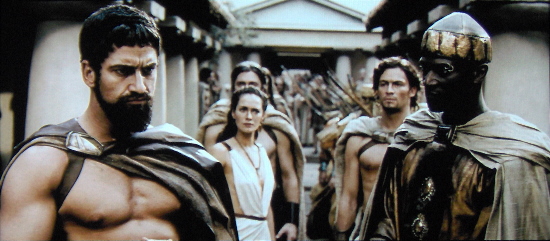 Sometimes a preview, against the odds, tells you exactly what to expect of the movie. Such is the case with 300, the cinematic translation of Frank Miller & Lynn Varley's graphic novel. In its unapologetically fantastic visualization of the ancient Battle of Thermopylae (between the Spartans and the Persians in 480 BCE), both the graphic novel and its faithful adaptation truly provide a spectacle—something to see—but beyond that, all bets are off.
Much as Robert Rodriguez adapted Miller's Sin City to the screen, director Zack Snyder uses the original comic book panels as essential visual touchstones; to achieve the "live-action" snapshots, Snyder filmed his actors surrounded by green screens. The director delivered a loose, unpretentious action-horror flick in his debut feature, a Dawn of the Dead remake, but 300 is a lumbering "beast" or, if you prefer, "monster."
Those terms, used ominously to describe the Persian enemy, betray the story's outsized bias in favor of the Spartans, and its patent unreality. Miller, Varley, and Snyder agree to break out literal beasts (a rhino, giant elephants) and mutant humans in an antic, Attic exaggeration of an already legendary nugget of history: how King Leonidas of Sparta and 300 men played a pivotal role in holding off a massive Persian invasion.
300 agressively paints the Persians as exotic, inglorious Others, presumably to show the subjective viewpoint of the Spartans. Xerxes (an unrecognizable Rodrigo Santoro) is everything the brave and bold Leonidas isn't: dishonorable, soft, and sexually dubious. "Today we rescue the world from mysticism and tyranny!" crows Leonidas, conveniently forgetting that his grudging visit to an oracle was an obligatory Spartan gesture.
The Spartans' harsh warrior culture forbade the sympathy and honor Homer allows for the Trojans in The Iliad, and though the film's xenophobia is consistent with Miller's source material (which predates post-9/11 demonizations), the timing of the film's release puts glamorized martial sacrifice to take down a dehumanized enemy squarely in the middle of our War on Terror. Since the film is such a blood-pumping endorsement of offense as defense, it's hard not to notice the Spartans are depicted as red-caped white guys going against noticably swarthier foes.
As compensation for his more fanciful strokes, Miller takes several of his version's most notable lines—like Queen Gorgo's exhortation "Come back with your shield or on it"—from Greek historian Herodotus and later biographer Plutarch. Gerald Butler (The Phantom of the Opera) plays Leonidas with appropriately steely focus, centered ferocity, and well-protected gloom over his certain fate. Gorgo (a properly tough Lena Headey) proves a good match, swallowing her fear and backing up her husband (the manner in which she does so includes both feminine humiliation and masculine retribution). Snyder's interpolated subplot—about Gorgo petitioning for troop support—takes Miller further from known history; in reality, the 300 Spartans weren't alone, but the pivotal forward line of a much larger force bolstered by Greek army and navy.
Stylistically, there's nothing spartan about the film. Eye-catching designs and splashy visuals reflect the visual impact of the graphic novel and the processing speed of a short-attention-span culture (like a video game, 300 has hyperbolic graphics; as in an NFL broadcast, there's frequent slo-mo better to appreciate the action). The ultimate irony is that movies like Sin City and 300, boiled down, are films for those too lazy even to turn the pages of graphic novels, which produce the original, equally arresting images for considerably fewer hundreds of millions of dollars.
As a Spartan mood piece, 300 communicates the glorification of war, and the values one sought in fighting it: honor, respect, duty, and glory. 300's selective approach to history demonstrates that its true interest isn't in anthropology so much as a timeless machismo. Snyder embraces the Greeks' exaltation of the idealized human form, and while sensual female nudity appears, it's the soldiers in leather undies who command most of the screen time. Their superheroic prowess on the battlefield defines them; emotions—though acknowledged—channel directly into a uniform expression of bloody assault (fillips of dry wit help make the crushing dread bearable). In context, it becomes reasonable to show love for family not through words but by impaling the enemy.
So what will audiences emerging from the multiplex take back with them into the 21st century? "Awesome" bloodlust and a reinforcement of retrogressive cultural attitudes. Primally, 300 has a grunting, gut impact; stirring archetypes; and the visual sweep of a projected nightmare. Primarily, it's constructed of fudged history and creative slaughtering, making it a somewhat disturbing American busman's holiday.


 Permalink
 |
|
 |
|
 |
Zack Snyder's 300 has already been issued once on Blu-ray, in an ordinary case with a humble smattering of bonus features. To coincide with the Blu debut of Snyder's Watchmen, Warner has delivered a long-rumored reissue of 300 on Blu-ray as 300: The Complete Experience. Whether or not it's worth an upgrade to early adopters will depend on their level of fanaticism, but there's no question the new version delivers much more substantial extras, tucked within handsome book-style packaging (44 glossy pages with photos, a guide to the disc, cast list, cast and crew bios, and select quotations by the likes of Snyder and Frank Miller. The transfer remains the same, and it's completely true to Snyder's vision, accurately and sharply reproducing the original grainy and stylized imagery. Audio also gets a robust treatment, with Dolby TrueHD 5.1 and Dolby Digital 5.1 options that rock the house with thunderous battle and martial music.
The big reason to upgrade is a new Blu-ray exclusive. Seemingly the entire cast and crew, as well as outside experts like historian Victor Davis Hanson, participate in The Complete 300: A Comprehensive Immersion, "a Multi-Path Interactive Experience" with Focus Point featurettes, Trivia, and Picture in Picture video of behind-the-scenes footage and interviews. As director Zack Snyder explains in his multimedia intro (2:12, HD), one must choose one of three paths (and/or toggle between them on the fly): Creating a Legend (focus on Frank Miller and his cultural and historical inspirations in developing the graphic novel), Bringing the Legend to Life (behind the scenes of the film's production), and The History Behind the Myth (a deconstruction/comparison of the fact and fiction concerning the Spartans). Green, Blue and Yellow icons during playback indicate the presence of material from one or more of the paths; one can also jump to content from a special menu (not unlike Universal's U Control menus).
The Complete Experience edition delivers a cheery commentary with Snyder, screenwriter Kurt Johnstad and director of photography Larry Fong, as well as Snyder's solo Bluescreen Picture in Picture Commentary, in which he compares the Bluescreen composite to the finished feature. Both pack in plenty of information about the film's making.
The rest of the bonus features make return appearances from the previous edition. "The 300 - Fact or Fiction?" (24:36, HD) is a terrific, honest appraisal of how 300 fits into a tradition of telling the story in larger-than-life fashion. Interviewees include author and historian Dr. Victor Davis Hanson, Snyder, Miller, author and historian Bettany Hughes, and Gerard Butler.
"Who Were the Spartans?: The Warriors of 300" (4:32, HD) continues the theme of putting the film into a historical context. Snyder, Miller, Rodrigo Santoro, Hughes, Butler, David Wenham, and Hanson comment.
"Preparing for Battle: The Original Test Footage" (6:43, HD) includes the two-minute test reel, as well as interviews with Snyder, Miller, producers Gianni Nunnari & Mark Canton, and executive producer Deborah Snyder about how they overcame skepticism to get the film a greenlight.
The very cool "Frank Miller Tapes" (14:42, HD) comprises "unfiltered conversations" with Miller and friends including DC Comics President/Publisher Paul Levitz, comic book creator Neal Adams, Snyder, and DC group editor Bob Schreck.
"Making of 300" (5:51, SD) appears to be the film's original EPK, including behind-the-scenes glimpses and interview clips with Snyder, Miller, Butler, Lena Headey, screenwriter Kurt Johnstad, visual effects supervisor Chris Watts, and Spartan trainer Mark Twight.
"Making 300 in Images" (3:40, SD) is an artsy montage, including time-lapse photography, of production footage and set construction.
Twelve "Webisodes" (38:23, SD) cover "Production Design," "Wardrobe," "Stunt Work," "Lena Headey," "Adapting the Graphic Novel," "Gerard Butler," "Rodrigo Santoro," "Training the Actors," "Culture of the Sparta City-State," "A Glimpse from the Set: Making 300 the Movie," "Scene Studies from 300," and "Fantastic Characters of 300."
Three "Deleted Scenes" (3:23, HD) include introductions by Snyder.
A Digital Copy comes in a colorful cardboard sleeve, and BD-Live functionality rounds out the extra enticements. This impressive deluxe set will most likely never be beat for this title: it's hard to imagine what other bonus features could ever be added, and the glossy packaging will add a bit more prestige to your shelf.
 |
|
 |
| Review gear: |
Panasonic Viera TC-P55VT30 55" Plasma 1080p 3D HDTV
Oppo BDP-93 Universal Network 3D Blu-ray Disc Player
Denon AVR2112CI Integrated Network A/V Surround Receiver
|
Pioneer SP-BS41-LR Bookshelf Speaker (2)
Pioneer SP-C21 Center Speaker
Pioneer SW-8 Subwoofer
|
|---|