

 RSS or
 Email.

Sponsored Links
Related Reviews
Mike Myers
-
Dr. Seuss The Cat in the Hat (2003)

-
Austin Powers: International Man of Mystery (1997)

-
Austin Powers in Goldmember (2002)
-
Shrek (2001)


-
The Love Guru (2008)

-
Wayne's World (1992)

-
Wayne's World 2 (1993)
-
Inglourious Basterds (2009)
Cameron Diaz
-
The Holiday (2006)

-
In Her Shoes (2005)
-
Charlie's Angels: Full Throttle (2003)
-
Gangs of New York (2002)
-
What Happens in Vegas (2008)
-
The Mask (1994)
-
Any Given Sunday (1999)
-
There's Something About Mary (1998)
-
My Sister's Keeper (2009)
-
Knight and Day (2010)
-
The Green Hornet (2011)
-
The Counselor (2013)
-
The Other Woman (2014)
-
Sex Tape (2014)
Eddie Murphy
-
Norbit (2007)
-
Dreamgirls (2006)
-
Daddy Day Care (2003)
-
Meet Dave (2008)
-
Tower Heist (2011)
-
You People (2023)
Antonio Banderas
-
Take the Lead (2006)
-
Spy Kids 2: The Island of Lost Dreams (2002)
-
Evita (1996)
-
You Will Meet a Tall Dark Stranger (2010)
-
Original Sin (2001)

-
Assassins (1995)
-
Haywire (2012)
-
Ruby Sparks (2012)
-
Philadelphia (1993)
-
The Expendables 3 (2014)
-
The SpongeBob Movie: Sponge Out of Water (2015)
-
The 33 (2015)
-
Pain and Glory (2019)
-
Indiana Jones and the Dial of Destiny (2023)

Julie Andrews
-
The Princess Diaries 2: Royal Engagement (2004)
-
The Sound of Music (1965)
-
10 (1979)
-
Mary Poppins (1964)
Chris Miller


Shrek the Third
(2007)

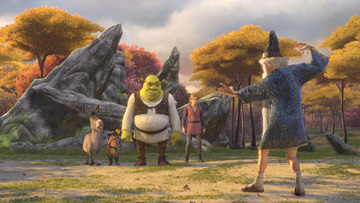 The original Shrek was built around potshots at the Disney legacy, and second sequel Shrek the Third resuscitates this agenda. The Disney-bashing, however, doesn't go down so easy when the crappy, insincere alternative is Shrek the Third, an even more creatively exhausted sequel than Shrek 2.
The first joke in the picture comes as one of the characters heckles Prince Charming's stage show: "This is worse than Love Letters!" The joke is a measure of the picture's panicky quest to entertain adults and kids at the same time, but if you get the A.R. Gurney gag, it's unlikely you'll go for most of the rest of the picture, which is aimed squarely at the three-foot set. Excepting, of course, the scene where a transsexual punches out a woman—that's fun for the whole family.
As Shrek and Fiona settle into married life, contemplate children, and provisionally fill the shoes of royalty, Charming (voice of Rupert Everett) gathers the villains around Far Far Away and promises them their long denied "happily ever after." "There are two sides to every story," he blusters. "And ours has never been told." Not quite true, but let's say you roll with it. What follows is an unpleasant regurgitation of the first picture's entertainment gambits: scatological humor, self-aware cutesy animals, old-is-new humor ("Ye Olde Foot Locker"—is this even a joke?), and a music-clearance bill that could feed sub-Saharan Africa for a decade.
The amusing vocal work of Everett and Antonio Banderas (Puss in Boots) has never seemed more wastefully applied. Bringing a bit of new energy, Justin Timberlake does his teenybopping best as king-apparent and being-yourself poster-boy Arthur Pendragon, but the rest of the cast—including stars Mike Meyers, Cameron Diaz, and Eddie Murphy—is strictly on autopilot. The good bits: the Gingerbread Man's life flashing before his eyes, the trailer-spoiled routine of Pinocchio obfuscating his lies to rein in his nose, and a mildly irreverent sequence of a not-quite-dead-yet frog repeatedly croaking.
Even these best bits are sloppy seconds from Shrek's misunderstood artistic godfathers, Monty Python. Once John Cleese exits the picture, in comes Eric Idle as Merlin. For disembodied old-age pensioners, the two are still pretty amusing, but they're clearly slumming in this picture, as are a clutch of creative contributors and consultants that include original Shrek co-director Andrew Adamson and Oscar-winning screenwriter Ted Tally. No one but patrons with fistfuls of dollars can save this cash grab from itself.


 Permalink
 |
|
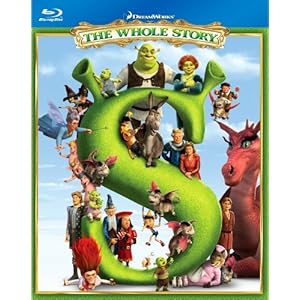 |
The picture quality of the four Shrek films seems to get better as the films progress, though it's a bit of a trick of the mind. All four transfers are equally good at recreating the original source material: it's the CGI animation that evolves over the decade-long span of the films. The hi-def images are uniformly razor-sharp and brilliant in the bold color representation. Detail and texture become more impressive with the increased detail and texture of the animation, but rest assured these transfers maximize the original elements. And are you ready for this? All four films get lossless Dolby TrueHD 7.1 mixes. These top-of-the-line, state-of-the-art mixes burst with activity and energy, keeping all elements in perfect balance: dialogue is never less than crystal clear, the steady stream of music is full-bodied, and the many crowd scenes and action sequences bristle with life.
Extras are...voluminous. All four films get the Picture-in-Picture feature The Animators' Corner, an illustrated video commentary tracing all aspects of the filmmaking from pre-production to post-production. All four films also get the Shrek's Interactive Journey treatment, with a hyperlinked map taking viewers to design artwork about that environment. Secrets of... (HD) for each film delve into the voice cast, animated "Easter Eggs" in the nooks and crannies of the film frames, pop cultural allusions, and more. And of course we get the ever-present DreamWorks Animation Jukebox, with music videos from other DreamWorks Animation films.
Shrek comes with a filmmakers commentary track featuring directors Andrew Adamson and Vicky Jenson and producer Aron Warner. Featurettes and additional footage include "Spotlight on Donkey" (11:38, HD), focused on the voice cast; the music videos "'Best Years of Our Lives' by Baha Men" (3:08, SD) and "'I'm a Believer' by Smash Mouth" (3:15, SD); "Shrek in the Swamp Karaoke Dance Party"Shrek the Musical (2:53, HD); musical number "What's Up Duloc?" from (3:57, HD); and three "Deleted Scenes" (8:01, SD) round out this collection of extras.
Shrek 2 includes filmmakers commentary with directors Kelly Asbury and Conrad Vernon and a separate commentary with producer Aron Warner and editor Michael Andrews. Featurettes and additional footage include "Spotlight on Puss In Boots" (10:46, HD); "Far Far Away Idol" (5:53, HD), a short with an animated Simon Cowell, Shrek, and Fiona judging the Far Far Away version of American Idol; music videos "'Accidentally in Love' by the Counting Crows" (3:22, SD) and "'These Boots Are Made For Walking' by Puss In Boots" (2:17, SD); and musical number "I Know It's Today" from Shrek the Musical (5:36, HD).
Shrek the Third extras include "Spotlight on Fiona" (9:53, HD); eco-friendly featurette "How to Be Green" (4:03, HD); Worcestershire Academy Yearbook (HD); four "Deleted Scenes" (25:56, SD); "Donkey Dance" (0:35, HD); and musical number "Freak Flag" from Shrek the Musical (3:58, HD).
Shrek Forever After kicks off with commentary track with director Mike Mitchell, writer-performer Walt Dohrn, and producers Gina Shay and Teresa Cheng. Featurettes and additional footage include "Spotlight on Shrek" (13:46, HD); three "Deleted Scenes" (5:44, HD); "Conversation with the Cast" (9:18, HD) with Mike Myers, Eddie Murphy, Cameron Diaz, and others; "The Tech of Shrek Forever After" (7:32, HD); and music video "Darling I Do" (4:00, HD). This time, Shrek the Musical gets a bit more coverage: "From Swamp to Stage: The Making of Shrek the Musical" (8:13, HD) and musical number "Who I'd Be" (1080p, 3:56). Also on hand: "Shrek's Yule Log" (30:18, HD, Dolby TrueHD 7.1), a franchise-themed video fireplace; "Donkey's Caroling Christmas-Tacular" (5:11, HD, Dolby TrueHD 7.1) with optional karaoke subtitles; "12 Days of Christmas Pop-Up Book" (2:18, HD), as told by Shrek himself; interactive game Donkey's Decoration Scramble (HD); and "Cookin' With Cookie" (4:54, HD), with recipes for Baked Chimichangas, Ogre Orange Slices, Puss' Peanut Butter Yule Logs, Gingy's Gingerbread Cookies, and Donkey's Mouthwatering Waffles.
With two of the films making their Blu-ray debuts and some brand-new bonus features, this release is definitely enticing for Shrek fans (the only proviso is that a Blu-ray 3D collection—currently a Samsung exclusive—provides another choice of how to view the films at home).
|
| Review gear: |
Panasonic Viera TC-P55VT30 55" Plasma 1080p 3D HDTV
Oppo BDP-93 Universal Network 3D Blu-ray Disc Player
Denon AVR2112CI Integrated Network A/V Surround Receiver
|
Pioneer SP-BS41-LR Bookshelf Speaker (2)
Pioneer SP-C21 Center Speaker
Pioneer SW-8 Subwoofer
|
|---|