

 RSS or
 Email.

Sponsored Links
Related Reviews
Allen Coulter
-
Hollywoodland (2006)

-
Sons of Anarchy: Season One (2008)


-
The Sopranos: The Complete First Season (TV) (1999)

-
Remember Me (2010)

Carl Franklin
John Maybury
Michael Apted
-
Amazing Grace (2007)
-
The World Is Not Enough (1999)

-
Chasing Mavericks (2012)
-
Masters of Sex: Season One (2013)
-
Masters of Sex: Season Two (2013)
Ray Stevenson
Kerry Condon
James Purefoy
Ciaran Hinds
-
Stop-Loss (2008)
-
The Nativity Story (2006)
-
Miami Vice (2006)
-
Munich (2005)
-
Veronica Guerin (2003)
-
Lara Croft — Tomb Raider: The Cradle of Life (2003)
-
Race to Witch Mountain (2009)

-
Harry Potter and the Deathly Hallows - Part 2 (2011)
-
Life During Wartime (2010)
-
The Debt (2011)
-
John Carter (2012)
-
Closed Circuit (2013)
-
Justice League (2017)
-
First Man (2018)
-
Frozen II (2019)


Rome—The Complete Series (TV)
(2005)

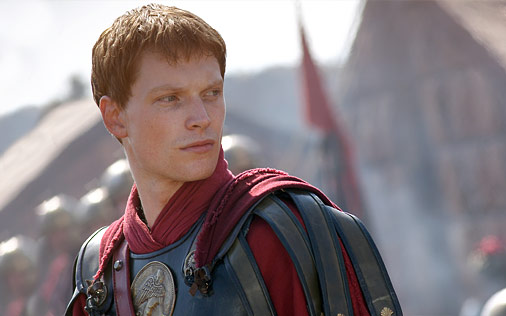 Whether you're talking about an empire or a TV series, it doesn't get much bigger than Rome. The first season in 2005, co-produced by HBO and the BBC, cost more than $100 million and filmed at Rome's Cinecittà Studios, known as the world's largest stage. The series was slow to catch fire with audiences as it retold the tragic tale of Julius Caesar, but to the delight of devoted critics and viewers, HBO greenlit a second and final season, with a reduced order of ten episodes. Those episodes continue the series' glory by exploring the complex aftermath of Caesar's assassination.
Creator Bruno Heller and co-producer and historical consultant Jonathan Stamp thoroughly evoke ancient Roman lifestyles along with the broader strokes of history, taking us from the halls of power and game-changing battlefields to the slums and collegiums (gang centers) that represented the common Romans' daily life. The principal players, then, inhabit these two intersecting worlds, which have in common two indelible characters: ex-legionaries Lucius Vorenus (Kevin McKidd) and Titus Pullo (Ray Stevenson). Friends and rivals, depending on their immediate fortunes, the characters share an inseparable bond that can be amusing, deadly serious, or touching—sometimes all at once—and without shying from the characters' brutality, the actors make Vorenus and Pullo lovable. Heller gives himself the most fictional flexibility with these characters, mentioned in the writing of Julius Caesar; even so, the writers are careful to make their most daring historical reaches plausible, consistent, and, of course, dramatically effective.
Dramatic concerns always come first, but the series hews more closely to history with the better known characters: Octavian (Max Pirkis, later replaced by Simon Woods), the surprise heir to Caesar; his mother Atia (Polly Walker), nearly his equal in ruthlessness; Marc Antony (James Purefoy), who path leads from war hero and Consul to traitorous, adulterous lover of Cleopatra (Lyndsey Marshal); Cicero (David Bamber), trusted but treacherous statesman; exiles Brutus (Tobias Menzies) and Cassius (Guy Henry); Servilia (Lindsay Duncan), Brutus' mother (and former lover of Caesar); and Octavian's sister Octavia (Kerry Condon). Season One's twelve episodes span 49 BC-44 BC, when the Ides of March come home to roost. Season Two marches onward through to span the years 44 B.C. to 29 B.C., in ten ambitious and audacious episodes. Heller and Stamp succeed in making the truncated series seem fast-paced rather than rushed as history hurtles toward the end of the Roman Republic.
The horrifying feud between Atia and Servilia shames the pawing of network-soap catfighters, and Rome takes full advantage of its freedom from censors with bold use of torrid sex and gory violence. It all serves to give a palpable sense of Roman mores and the realities of a survival-of-the-fittest culture. Plus, it's damn entertaining. Season Two deepens the series' astute sociological interests by exploring the politics of Jews in Rome through the character of Timon (Lee Boardman)—a trader and mercenary for Atia—and Timon's newly arrived brother Levi (Nigel Lindsay), who involves Timon in political terrorism. With touchstones such as the decisive Battle of Philippi, a massive civil-war clash of roughly 200,000 soldiers, Rome spectacularly brings history alive.


 Permalink
 |
|
 |
Rome—The Complete Series gets a deluxe ten-disc Blu-ray set that at last allows the series to reach full-flower on home video. The episodes, appearing two or three to a disc, represent state-of-the-art video and audio quality, in 1080p hi-def widescreen and DTS-HD Master Audio 5.1. The episodes have an appealingly film-like appearance and retain the series' visual scheme of striking contrast (blacks are nice and deep, and the frequent outdoor location footage shines, literally and in its depth of field); there's a bit of mild artifacting here and there, but texture and detail and strong. The lossless sound mixes are even more robust in their presentation of immersive soundscapes that place the listener firmly into each historical setting and give full body to the musical scoring. Each disc also includes illuminating supplementary material, including Bloodlines, an interactive pop-up interface with character dossiers and connections, and the invaluable All Roads Lead to Rome interactive onscreen guide, a subtitle track accompanying every episode with historical details provided by the series' co-producer and historical consultant Jonathan Stamp.
Season One, Disc One includes commentary with executive producer/writer Bruno Heller and Stamp on the first two episodes, as well as the first-season overview "Friends, Romans, Countrymen" (11:01, SD) and the behind-the-scenes making-of doc "The Rise of Rome" (23:35, SD). Disc Two adds commentary by Ray Stevenson on "The Ram Has Touched the Wall." Disc Three offers commentary with Heller and Stamp on "Pharsalus" and director Steve Shill on "Caesarion." Disc Four includes commentary by director Jeremy Podeswa on "Utica," as well as the featurette "Shot X Shot: Caesar's Triumph" (22:50, SD), "Detailing the production of the epic Episode 10 triumph scene." Disc Five features audio commentary by Kevin McKidd on "The Spoils" and by Heller and Stamp on "Kalends of February." Also on Disc Five: "Shot X Shot: Gladiator" (23:00, SD) looks more closely at Episode 11's fight sequence, and "When in Rome" (22:40, SD) looks at ancient Roman life, including religion and class structure.
Season Two, Disc One leads off with the first audio commentary (Stamp and creator Bruno Heller on Episode 1), which largely reiterates the All Roads Lead to Rome trivia track. More useful is the extensive featurette "A Tale of Two Romes" (20:30, HD), with Stamp and Heller joined by executive producer John Melfi and actors Ray Stevenson, Lee Boardman, and Polly Walker. Beginning with the founding of Rome in 753 B.C., the doc gives an overview of the historical rivalries that fuel Season Two, as well as relevant cultural issues (the class divide, religion, sex, and drugs).
Season Two, Disc Two continues to offer the All Roads Lead to Rome tracks, while Disc Three adds the comprehensive featurette "The Making of Rome Season II" (22:52, HD). Revealing on-set footage, concept art, blueprints, and storyboards accompany comments by the lion's share of the cast and crew: in addition to Stamp, Heller, Melfi, Stevenson, and Walker, we get writer Eoghan Mahony and directors Allen Coulter, Tim Van Patten, and Roger Young; actors Kevin McKidd, James Purefoy, Lyndsey Marshal, Simon Woods, Kerry Condon, Tobias Menzies, and Allen Leech; production designer Anthony Pratt; costume designer April Ferry; military trainer Billy Budd; unit production manager Fabiomassimo Dell'Orco; co-executive producer Jim Dyer; visual effects supervisor James Madigan; Special effects supervisor Daniel Acon; and key hair stylist Stefano Ceccarelli. A special focus is given to the recreation of the Battle of Philippi.
On Season Two, Disc Four, director John Maybury and Marshal (Cleopatra) accompany "Death Mask," and director Carl Franklin and Melfi comment through "A Necessary Fiction." The doc "The Rise of Octavian: Rome's First Emperor" (20:44, HD) considers the ruthlessness and greatness of the man who would be Caesar Augustus. Max Pirkis is notably absent, but his successor Simon Woods picks up the slack, along with Stamp, Heller, Stevenson, and Leech.
Season Two, Disc Five includes two more audio commentaries: James Purefoy proves his raconteur credentials in his solo commentary on "Deus Impeditio Esuritori Nullus (No God Can Stop a Hungry Man," and Heller and Stamp accompany the series' final episode, "De Patre Vostro (About Your Father)." A final featurette, "Anthony & Cleopatra" (14:48, HD), details the doomed lovers, with comments by Stamp, Marshal, Purefoy, Heller, Melfi, Menzies, and McKidd.
Completing the effect of this special edition set, the ten discs comes inside a colorful book-style package with thick foam-core pages housing each disc. Sure to be regarded as a classic television series in years to come, Rome burns brightly on Blu-ray.
 |
| Review gear: |
Panasonic Viera TC-P55VT30 55" Plasma 1080p 3D HDTV
Oppo BDP-93 Universal Network 3D Blu-ray Disc Player
Denon AVR2112CI Integrated Network A/V Surround Receiver
|
Pioneer SP-BS41-LR Bookshelf Speaker (2)
Pioneer SP-C21 Center Speaker
Pioneer SW-8 Subwoofer
|
|---|