

 RSS or
 Email.

Sponsored Links
Related Reviews
-
The Bourne Legacy (2012)


-
Jason Bourne (2016)

-
The Bourne Supremacy (The Bourne Trilogy) (2004)

-
The Bourne Identity (The Bourne Trilogy) (2002)
Matt Damon
-
The Good Shepherd (2006)

-
The Departed (2006)

-
Syriana (2005)

-
The Brothers Grimm (2005)
-
Ocean's Twelve (2004)
-
Stuck on You (2003)
-
Gerry (2003)
-
Ponyo (2009)
-
Green Zone (2010)
-
Invictus (2009)
-
Inside Job (2010)
-
The Adjustment Bureau (2011)
-
Mystic Pizza (1988)
-
Happy Feet Two (2011)
-
We Bought a Zoo (2011)
-
Elysium (2013)
-
The Monuments Men (2014)
-
The Martian (2015)
-
Oppenheimer (2023)
Joan Allen
-
Bonneville (2008)
-
Off the Map (2005)
-
The Upside of Anger (2005)
-
The Notebook (2004)
-
Face/Off (1997)
-
Nixon (1995)
-
YES (2005)
-
Room (2015)
Julia Stiles
-
Edmond (2006)
-
The Omen (2006)
-
The Prince and Me (2004)
-
Mona Lisa Smile (2003)
-
A Guy Thing (2003)

-
Dexter: The Fifth Season (2011)
-
A Guy Thing (2003)

-
Closed Circuit (2013)
-
Orphan: First Kill (2022)
David Strathairn
-
My Blueberry Nights (2008)
-
Fracture (2007)
-
We Are Marshall (2006)
-
The Notorious Bettie Page (2006)
-
Good Night, And Good Luck. (2005)
-
Twisted (2004)
-
The Spiderwick Chronicles (2008)
-
The Uninvited (2009)
-
The Whistleblower (2011)
-
The Tempest (2011)
-
Lincoln (2012)
-
The Blacklist: The Complete Second Season (2013)
-
The Blacklist: The Complete Third Season (2013)
Paddy Considine
-
My Summer of Love (2005)
-
Cinderella Man (2005)
-
In America (2003)
-
Red Riding (2010)
-
The World's End (2013)
-
The Death of Stalin (2017)
Paul Greengrass


The Bourne Ultimatum (The Bourne Trilogy)
(2007)

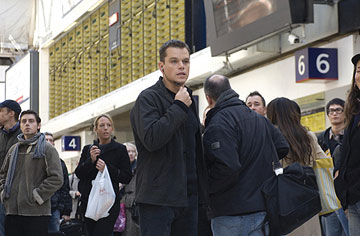 "Listen to me," Bourne exhorts to a naif in tow. "This isn't some story in a newspaper. This is real." Well, not quite, but he sums up his cachet as a cinematic challenge to the James Bond spy-movie establishment: keep it real. The most ridiculous entry in the Jason Bourne trilogy, Paul Greengrass' The Bourne Ultimatum, has an uphill battle. Predicated on finally delivering answers we basically already know (nasty government people trained him to be a deadly superspy—and—?) and cornered into bigger and better variations on the same basic action tropes, The Bourne Ultimatum turns out to be: be pretty damn exciting or get off the stage. Happily, Greengrass and screenwriters Tony Gilroy (The Bourne Identity, The Bourne Supremacy), Scott Z. Burns and George Nolfi pull a few more tricks out of the bag.
The Bourne Supremacy dispatched one of the principal baddies behind the Treadstone program that spawned Bourne. This time, a "treadstone upgrade" called Blackbriar stirs up trouble, and a once-more-framed Bourne (Matt Damon, still convincingly steely) begins digging again. More of his memory begins returning in flashes, putting him on the trail of Treadstone's scientific architect, Dr. Albert Hirsch (Albert Finney). Hot on Bourne's trail: CIA internal investigator Pamela Landy (Joan Allen, again) and Noah Vosen (David Stathairn), the understandably squirrelly CIA honcho responsible for Blackbriar. Time for Bourne to bruise his knuckles stymieing team after CIA team.
Gilroy and the rest spin clever variations on the previous films, and they acknowledge where they've been by emphasizing visual motifs of the series. (There's also a very clever trick involving the end of Supremacy—you might want to refresh your memory before going.) Understanding that Bourne works best in relief to awed companions, Ultimatum provides Simon Ross (Paddy Considine), a Guardian reporter in way over his head. Julia Stiles returns as agent Nicky Parsons, and Greengrass emphasizes her resemblance to Franka Potente, Bourne's erstwhile love: will new (or is it old?) romance blossom? Post-amnesiac Bourne was born from water in Identity; as Greengrass shows us, Bourne was first born in water (waterboarding, a timely image of torture) and returns there at trilogy's end.
Though Bourne's a one-woman man, the series' hallmarks come by way of Bond: exotic locales and spectacular action. Seven major cities turn up in the briskly paced Supremacy, most notably London, Tangier, and New York. A crackerjack sequence in Waterloo Station once again pits Bourne's wits against an army of field agents and a roomful of surveillance analysts watching live video feeds. In Tangier, Bourne participates in a pulse-pounding chase that unfolds simultaneously in alleyways and rooftops, and New York is the concrete stage for another demolition derby. The nagging feeling of "been here, done this" is exacerbated by Greengrass's continued excess of drunken, disorienting shaky-cam: lightning-quick moves and speeding cars in whiplash shots and quick cuts. Still, the action is undeniably kinetic and armrest-gripping.
Part three stretches its hero's physical resilience beyond credibility (what is this, Live Free or Die Hard?), but this installment improves on the other films in one important sense: Ultimatum feels more of its moment than either of the other films. Bourne is a character inextricably caught up in American wrongdoing, and tortured by it. Culpable and conflicted, he is driven by a desire to disable the engineering of American covert action, one recognizable form of halls-of-power corruption. In other words, Bourne is the perfect hero for audiences who feel impotent during an unpopular war. A sequel isn't out of the question, but the third chapter provides suitable closure for what may and should be a graceful end to the franchise.


 Permalink
 |
|
 |
The Bourne Ultimatum races onto Blu-ray as a part of Universal's The Bourne Trilogy box set. Universal Home Video knows Bourne is a jewel in the crown, and they've assembled a very nice special edition for The Bourne Ultimatum, beginning with an awesome sight-and-sound presentation. The film transfer is top-notch, and as one might expect the most recent film is the best-looking in the set. I can't imagine the picture quality could be any better: colors are spot on and detail is excellent. The overall impression is a smooth, vibrant but naturally film-like look that accurately represents how the film appeared on the big screen (without any of the distractions of poor projection). Given the film's intentionally rough-and-tumble appearance, this transfer does the film justice and is the definitive version on the market. The DTS-HD Master Audio 5.1 surround mix is simply awesome, with spectacular directionality and powerfully detailed effects.
Blu-ray exclusives will be familiar to loyal Universal customers, beginning with three core U-Control features: a Picture in Picture option that includes cast and crew interviews, set footage, and pre-production art (like storyboards); the Blackbriar Files, which give access to high-tech superspy information technology (like pop-up Agent Status, Character Dossiers, Field Reports with "GPS-enhanced satellite views of the locations," and "the technology behind the spy gadgets through visuals and 3D animations"); and Bourne Orientation, which jumps out of the film to provide literal orientation (globally speaking) and figurative orientation: information about what's driving Bourne at key junctures in the story (answering that eternal actor's question: "What's my motivation?"). There's also a Volkswagen Get More Info feature that, timed to the car chase, gives specs of the car—y'know, just in case you're in the market for a car that'll hold up well in a high-speed demolition derby.
The hi-def exclusives continue with Be Bourne Spy Training, a "spy aptitude test" that's pretty much a time waster (and therefore perhaps just the thing for bored school-age kids).
Naturally, there's also a My Scenes bookmarking feature, and BD Live takes the viewer out to additional features on the internet, among them My Chat, My Movie Commentary, and Bourne Card Strategy Challenge, a "hand-to-hand combat strategy game," using digital cards, with which you can challenge other friends online.
The detailed screen-specific audio commentary by director Greengrass goes into the narrative approach to the second sequel scene by scene and character by character.
Given the film's reportedly chaotic development, there's probably five times as much fascinating footage as we get in a tantalizing selection of "Deleted Scenes" (12:22, SD), but we're given trims that compliment the finished product: CIA Director Ezra Kramer (Scott Glenn) testifying before Congress and firing Landy, a slaying on the streets of Spain, Ross getting a point in the right direction, Bourne attempting to squeeze information from a contact, extra footage from the Waterloo Station sequence, two strategic pow-wows between Landy and Vosen, and Bourne seeing off Parsons.
"Man on the Move: Jason Bourne" (23:57) is a five-part look—with a "Play All" option—at the film's principal international locations: Berlin, Paris, London, Madrid, and Tangier. Behind-the-scenes footage in Berlin shows Damon joking around with Greengrass and doing his own stunt: jumping off a train (a first for the star). Producers Patrick Crowley and Paul Sandberg, Berlin location chief Marcus Bensch, Lucian Stevenson of SnowBusiness (the go-to company for fake snow), stuntman Adam Kirley, 2nd Unit Assistant Director Robert Grayson, visual effects supervisor Charlie Noble explain how and why Berlin doubles for Moscow, and the pitfalls of shooting in a train station.
Camera operator Klemens Becker, still photographer Jason Boland, and producer Frank Marshall add their two cents in Paris, where we see Damon coached on his French lines. In London, location manager Sam Breckman, Second Assistant Director Michael Stevenson, Terry Rigarlsfoid (Matt Damon's security guard), and actor Edgar Ramirez join the conversation as we watch the monumental undertaking of a four-day shoot in Waterloo Station. The Madrid segment adds comments from Sound Mixer Kirk Francis, 2nd Assistant Director Tom Brewster, and actors Scott Atkin, Chucky Venice, and Paddy Considine (doing his Borat impression!).
Lastly, Tangier finds actor Joey Ansah, Morocco location manager Jafar, Morocco line producer Zakaria Alaoui, supervising art director Alan Gilmore, Julia Stiles, and Moroccan guide Simo putting in their two cents about the challenge of filming in a medina during Ramadan. Damon and Greengrass give off a surprisingly cheery energy throughout; an interesting theme that emerges is the difficulty of filming in public with a star of Damon's caliber—an task made easier outside of America and England.
"Rooftop Pursuit" (5:39, SD) puts Damon, Greengrass 2nd Unit camera operator Peter Wignall, 2nd unit director Dan Bradley, special effects wire supervisor Jason Leinster, 2nd Unit Libra technician Joe Buxton, Bourne stunt double David Leitch, stunt coordinator Gary Powell, special effects technician Hayley Williams, and stuntman/JumpCam operator Diz Sharpe on record about the Tangier chase sequence. What's a JumpCam? It's a film camera in the hands of a leaping stuntman; we also get a gander at the rather amazing aerial "Cablecam" used to capture Bourne's rooftop run.
The super-cool featurette "Planning the Punches" (4:59, SD) interviews Ansah, Damon, fight stunt coordinator Jeff Imada, and Thomas Jones (coordinator of breakaway and safety props) about their collaboration on the martial-arts smackdown between Bourne and Desh, which we see developed in on and off-set rehearsals. We can also see the sequence of moves—which Damon aptly describes as dance-like—in lengthier, steadier shots. The equally interesting "Driving School" (3:23, SD) allows Bradley to explain (and us to witness) how "multi-talented bastard" Damon mastered with ease the driving stunts required for the New York car chase.
Finally, "New York Chase" (10:46, SD) takes us to production of that sequence, with intimate access and comments by Damon, Bradley, Becker, New York 2nd unit first assistant director Nick Satriano, picture vehicle supervisor Graham Kelly, stuntmen Kevin Scott and Scott Rogers, and second-unit stunt coordinator Darrin Prescott. The cumulative effect of the featurettes is to instill a deep respect for and awe toward the experts who make these logistically staggering, stunt-heavy location shoots happen.
The three discs of The Bourne Trilogy come packaged in a handsome, sturdy box with a magnetized flap (the flap depicts Damon as Bourne). Though some of the features are available on the DVD edition, the Blu-ray set The Bourne Trilogy is without doubt the best way to experience these films and to bone up before the in-development fourth entry reaches theaters.
 |
| Review gear: |
Panasonic Viera TC-P55VT30 55" Plasma 1080p 3D HDTV
Oppo BDP-93 Universal Network 3D Blu-ray Disc Player
Denon AVR2112CI Integrated Network A/V Surround Receiver
|
Pioneer SP-BS41-LR Bookshelf Speaker (2)
Pioneer SP-C21 Center Speaker
Pioneer SW-8 Subwoofer
|
|---|