

 RSS or
 Email.

Sponsored Links
Related Reviews
Jeff Garlin
Sigourney Weaver
-
Baby Mama (2008)


-
Ghostbusters II (1989)

-
Ghostbusters (1984)

-
Imaginary Heroes (2004)

-
The Village (2004)
-
Tadpole (2002)
-
Vantage Point (2008)

-
Avatar (2009)
-
Alien Anthology (2010)
-
You Again (2010)

-
Cedar Rapids (2011)
-
Copycat (1995)
-
Exodus: Gods and Kings (2014)
-
Chappie (2015)

-
A Monster Calls (2016)
Andrew Stanton


Wall•E
(2008)

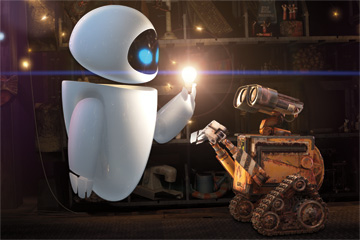 It's best not to ask too many questions during Wall•E, the new CGI-animated comedy from Pixar. Take the film's outstretched hand and go with it. That's the best way to enjoy a film that's as charming as a tale of two robots falling in love can be. Which, as it turns out, is pretty darn charming. As written and directed by Andrew Stanton (with co-writer Jim Reardon from a story by Stanton and Pete Docter), Wall•E develops some familiar themes of animated and science-fiction films, but the combination of elements results in a unique film. Like most heroes of children's films, Wall•E yearns for something more—but unlike those characters, Wall•E is a robot, and someone else is singing his song.
The story is best enjoyed as an unfolding narrative, so I'll tread gently on the plot. Wall•E (a.k.a. Waste Allocation Load Lifter Earth-Class) is the last robot on Earth, cleaning up the mess we're making now. It's an Earth with skyscrapers constructed of compacted garbage cubes, and the little robot is plodding away through the ongoing task, crushing and placing one garbage cube at a time. But sometime over the last 700 years, Wall•E not only became alone in his task, but began to develop an interest in the garbage, collecting from the detritus of civilization intriguing knick-knacks for himself: a lightbulb, a Rubik's Cube, a spork. That's right: just like us, this robot is baffled by sporks.
What caused the robot's presumable evolution from drone to a more developed and discriminating artificial intelligence is never addressed, but the key to "his" "humanity" is his prized piece of junk: a VHS tape of 1969's Hello Dolly! Over and over again, the little robot studies the emotions and gestures of its human characters, who stroll, dance, hold hands, and sing about a place that's "Out there, full of shine and sparkle" where there's "adventure in the evening air/Girls in white in a perfumed night/Where the lights are bright as the stars." The recycled musical yearning cleverly lends the film conventional wistfulness in an unconventional way.
Wall•E's routine is disrupted when another robot, named EVE, arrives on a secret mission and, well, sparks fly. Where their journey together takes them is best left to your own enjoyment of the film, but we do learn more about what's happened to humanity, and the conception of where our sorry butts end up is one I've long longed to see in a science-fiction comedy. The filmmakers overtly acknowledge the influence of 2001: A Space Odyssey (one robot in the film is specifically designed to resemble HAL 9000's evil eye—cue the "Blue Danube Waltz"), and internet wags have commented on Wall•E's resemblance to Number 5 from Short Circuit, but the most interesting resemblance is to the "B" Ark plot thread from Douglas Adams' Hitchhiker's Guide to the Galaxy series.
The animation and script are typically top-notch, as is the Pixar hallmark (but, again, don't ask questions like where the other thousand Wall•Es wound up, or whether the ending is a good idea—it’s emotionally right). Part of the genius of the film is purely technical: the use of greater photo-real techniques for the dusty landscapes, "shot" by the animators and their tools with purposely imperfect "lighting" and "focus" (reported advisors include visual effects pioneer Dennis Muren and photographers Roger Deakins and Harris Savides). The MVP is Ben Burtt, the legendary sound designer known especially for the robot voices in the Star Wars saga. Burtt does the key vocal work for the film, which spends a large chunk of its running time in an essentially dialogue-less mode familiar from Pixar shorts and silent films. (Another country heard from: Peter Gabriel, who co-wrote the song "Down to Earth" with composer Thomas Newman.)
Best of all, the film has a social conscience, with the demise of Earth largely credited to a single corporation ("Buy n Large") that swallowed the global economy whole. A world full of "stuff" winds up looking eerily desolate, including a disused-satellite ring-around-the-collar for the planet. There's a good balance here of pessimism about humanity that's ultimately rewarded by optimism, though what the film is especially optimistic about is robots, all of which develop suspiciously human emotions on the way to romance, saving a day, and perhaps—irony of ironies!— teaching humans to be more human. For a movie about precision mechanics, this one's likeably offbeat.
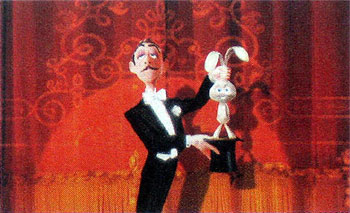 (The feature is preceded, as is Pixar's custom, with another boffo animated short: "Presto." It's a ridiculously entertaining five minutes about a magician feuding with his rabbit. Don't be late for the movie!)


 Permalink
 |
|
 |
Disney's 3-disc Blu-ray pulls out the stops. This is certain to be the definitive release for decades, until someone sifts through the golden era of Pixar anew. Everything one could wish from an initial home-video release is here: a reference-quality AV transfer, tons of extras (every bit of them in hi-def), and a bonus digital copy of the film. The image is stunning, perfectly representing the carefully crafted film-like image down to the last dusty or gleaming pixel. The image has a depth (aided by the photographic realism of the design) that truly pops, and the colors are rich and true. The DTS-HD Lossless Master Audio track is actually a 6.1 surround track, and not 5.1 as the packaging suggests. Like the image and the whole Blu-ray package, the track is definitive, flawlessly presenting the full range of Ben Burtt's brilliant sound design in discrete separation.
Disc one accompanies the film with several fascinating viewing options, most of which are Blu-ray exclusives. As on Sleeping Beauty, there's a fantastic "Cine-Explore" track marrying director Andrew Stanton's commentary to pre-production concept art and other images superimposed over the film. One can also watch the film with Stanton's audio commentary only, or with the "Geek Track" audio commentary that offers "trash talk and trivia" from a small group of Pixar staffers (they're seen in the lower portion of the screen, Mystery Science Theatre 3000-style). Better yet are the two short films that come on disc one. The first, "Presto" (5:14), accompanied Wall•E in theatres, and has to be considered a front-runner for an animated Short Subject Oscar--it's hilarious. The second, "Burn•E" (7:19) is a direct companion piece to Wall•E, a parallel story that shows us the travails of the Burn•E robot, unwittingly caused by Wall•E and Eve. It, too, is a keeper that will delight audiences of all ages; it can also be viewed with running storyboard comparison in P-i-P format hosted by director Angus MacLane.
Disc two houses most of the bonus features, many of which are designed to divert kids. But don't be surprised, parents, if you find yourself hogging the remote. In the "Robots" section," you'll find "Wall•E's Treasures and Trinkets" (4:54), a cute demo-style reel of Wall•E playing with various toys; "Lots of Bots" Storybook; a sneak peek of "Wall•E's Tour of the Universe" (:46), and the Blu-ray exclusive Axiom Arcade, with four addictively clever games: Eve's Bot Blaster, Wall•E's Dodge and Dock, M-O's Mop-Up Madness, and Burn•E's Break Through.
The "Humans" section offers deep-digging behind-the-scenes fare. Deleted Scenes (22:54) and alternate scenes come with intros by Stanton. Seven featurettes, taken together, comprise a Behind the Scenes documentary (1:09:45)--the best segment digs into how cinematographers like Oscar-winner Roger Deakins helped to shape the film's look, Deakins by doing a live demo at the Pixar campus. We get a few very cool BnL Shorts (8:45), Blu-ray exclusive 3D Set Fly-Throughs (10:38), a Gallery, and Worldwide Trailers (13:37 in all). A happy surprise is the inclusion of Leslie Iwerks' documentary film The Pixar Story (1:28:30), a comprehensive look at the early years of the company.
Film lovers of all ages will go gaga for Wall•E on home video, especially in the bells-and-whistles 3-disc Blu-ray edition.
 |
| Review gear: |
Panasonic Viera TC-P55VT30 55" Plasma 1080p 3D HDTV
Oppo BDP-93 Universal Network 3D Blu-ray Disc Player
Denon AVR2112CI Integrated Network A/V Surround Receiver
|
Pioneer SP-BS41-LR Bookshelf Speaker (2)
Pioneer SP-C21 Center Speaker
Pioneer SW-8 Subwoofer
|
|---|