

 RSS or
 Email.

Sponsored Links
Related Reviews
-
From Russia With Love (1963)


-
Dr. No (1962)
-
Casino Royale (2006)
-
Die Another Day (2002)

-
Thunderball (1965)
-
Live and Let Die (1973)
-
For Your Eyes Only (1981)
-
Moonraker (1979)

-
The World Is Not Enough (1999)
-
Never Say Never Again (1983)
-
The Man with the Golden Gun (1974)
Daniel Craig
-
The Invasion (2007)

-
Infamous (2006)
-
Munich (2005)
-
Layer Cake (2005)
-
The Mother (2004)
-
Road to Perdition (2002)
-
Defiance (2008)
-
The Girl with the Dragon Tattoo (2011)
-
Skyfall (2012)
-
Spectre (2015)
-
Logan Lucky (2017)
-
Knives Out (2019)
Judi Dench
-
Notes on a Scandal (2006)
-
Mrs. Henderson Presents (2005)
-
Ladies in Lavender (2005)
-
The Chronicles of Riddick (2004)

-
Home on the Range (2004)
-
Hamlet (1996)

-
Pirates of the Caribbean: On Stranger Tides (2011)
-
Jane Eyre (2011)
-
My Week with Marilyn (2011)
-
J. Edgar (2012)
-
The Best Exotic Marigold Hotel (2012)
-
Skyfall (2012)
-
Philomena (2013)
-
The Second Best Exotic Marigold Hotel (2015)
-
All Is True (2018)
Jesper Christensen
Mathieu Amalric
-
Le Scaphandre et le papillon (The Diving Bell and the Butterfly) (2007)
-
Kings & Queen (2005)
-
A Christmas Tale (Un conte de Noël: Roubaix!!) (2008)
-
At Eternity's Gate (2018)
Marc Forster


Quantum of Solace
(2008)

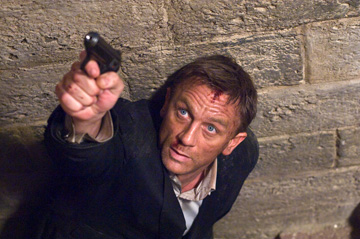 2006's James Bond reboot Casino Royale was happily received as a bold step away from some long-entrenched elements of the 45-year-old big-screen Bond formula: gadgetry, loveless sex, cartoony adventure, and a pervasive, winking sense of humor. The sequel, Quantum of Solace, ostensibly positions Bond to make strides back toward familiar territory. But first he must crash, crunch, and swing his way through a mission on the farthest outskirts of that formula. Despite the requisite eyecatching locales, second-to-none stunt work, sleek production value and excuse to don the finest of evening wear, the 22nd Bond film too often seems like an old friend on the wrong anti-depressant: still the person you love, but the rhythm's off and the precious moments fewer and further between.
Bond 22 is a letdown in the story department and, at times, needlessly confusing. Beginning only an hour after the events of Casino Royale, Quantum of Solace presumes intimate knowledge of the first film, the climax of which left Bond (Daniel Craig) bent on revenge. Vengeance would seem to be the only thing that can give Bond, as the Ian Fleming-derived title has it, a quantum of solace. The trail leads Bond to the doorsteps of a supersecret axis of evil named Quantum (hey, how about that?!), which, for more prosaic reasons, has the attention of both Bond's MI-6 masters and the CIA. Tangled up in Quantum's current plan for natural-resource-plundering regional domination is a general (Joaquín Cosío) hunted by Russian-Bolivian operative Camille Montes (Olga Kurylenko). She's too wrapped up in a quest for personal vengeance to dive between the sheets with an uneasy ally, although Bond takes a moment with Gemma Arterton's strawberry-haired Fields, another MI6 agent tasked with "handling" 007 (her swoony lapse of professionalism precedes a feeble feminist feint: "Do you know how angry I am with myself?").
Screenwriters Paul Haggis and Neal Purvis & Robert Wade (with an uncredited assist from Joshua Zetumer) get some mileage out of the mirrored tasks of James and Camille, both—according to business-like villain Dominic Greene (Mathieu Amalric)—"damaged goods." CEO of Greene Planet, the baddie walks among us as a rapacious and therefore respected wheeler-dealer. Recognizing that tomorrow's power lies not in oil but water, Greene has the pulse of the planet and the ear of the CIA. Bond's friendly American counterpart Felix Leiter (Jeffrey Wright) doesn't like what he smells, but he's outranked. The Company line also passes through the lips of M's superior: "If we refused to do business with villains, we'd have almost no one to trade with."
Lip service is repeatedly paid to this theme of villains hiding in plain sight and corruptible heroes. Returning player René Mathis (Giancarlo Giannini) explains that, as one gets older, "the heroes and villains get all mixed up." But saying it doesn't make it so: there's neither anything remotely good about Greene and his ilk nor anything particularly disturbing about the good guys' mortally brutal methodology, which may be inconvenient to the investigation but would pass as self-defense in any court of law. Should there be any moral aerobics (and I'm not convinced there are), they flutter briefly between Bond and M (the steely, seemingly ageless Judi Dench), who talks a lot about trust and levels her gaze for a complaint that circles back to Thematic Square One: "You're so blinded by inconsolable rage that you don't care who you hurt. When you can't tell your friends from your enemies, it's time to go."
When a Bond vehicle guns its engines, we're supposed to forget how hard everyone is working and be transported, make our escape. 21st-century Bond will probably always be a tasteful way to satisfy one's action fix, but director Marc Forster approaches Quantum of Solace with the kind-of brow-knitting excess of intensity that's doomed to cause the stumbling it's so focused on avoiding. The largely incoherent car chase that opens the picture shows us what to expect: frantic photography and cutting that frustratingly obscures the best stunt work money can buy. The adrenaline's there, but the fun has absconded. Compare the dizzying high that is Casino Royale's early parkour sequence, and you'll quickly recall what you're missing.
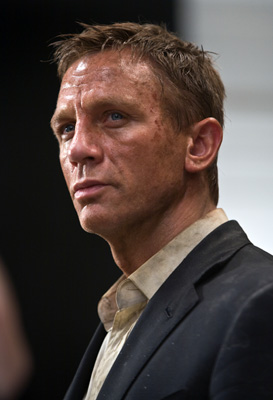 A subsequent chase through corridors and across rooftops improves matters (while inevitably evoking Jason Bourne's kinetic fights and leaps), but arrives at a high-wire fight—involving a scaffolding, ropes, and broken glass—with editing that can only be described as absurd. (And what are we to think about the superhuman moment of Bond's breathing failing to quicken after a pounding fight or another in which he breaks off a metal door handle with a snap of his bare hand?) Eager to impress, Forster presses self-consciously arty intercutting of colorful European pageantry into the action montage of two key sequences (okay, the Tosca scene is pretty nifty). The director fares best when he simply attempts to bookend Martin Campbell's work on Casino Royale, as in this film's fiery answer to that film's watery climax.
Almaric is asked to suppress the fine scenery chewing that made his name, and Kurylenko and Arterton are dully repetitive of more interesting "Bond girls" past. The picture belongs, then, to Craig—as well it should. Through no fault of Craig's, his Bond has hardened here into something dangerously close to its own kind of caricature, though one that will age better than the smug Bond of the early '80s. Craig wears it well, credibly embodying grim in-the-shit determination and smirking downtime, but the one thing everyone will most likely agree upon after watching Quantum of Solace is that we are all (Bond included) overdue for a bit of guilt-free fun.


 Permalink
 |
|
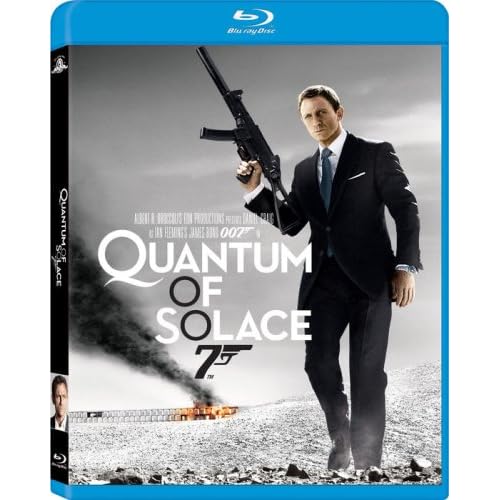 |
MGM and therefore Fox control the home video rights to Quantum of Solace, and they get back in the Bond business with the film's Blu-ray and DVD debuts. The opening shots have a bit of fluttery noise amidst the grain, but once the action kicks in a few seconds later, it's evident this transfer has the goods. Given how grainy and processed the source could be in its theatrical exhibition, the image here is a spot-on rendering of the director's intent, with plenty of detail and dimensionality. The barnstorming sound comes in DTS-HD Master Audio 5.1 that will tear the roof of your joint.
The bonus features kick off with the title-song "Music Video--Another Way to Die" (4:30, HD).
The slickly produced, globe-trotting promotional film "Bond on Location" (24:45, HD) serves up terrific behind-the-scenes footage and interviews. This brief, mostly chronological history of the shoot that literally and figuratively covers a lot of ground, as evidenced by the list of participants: director Marc Forster, producers Barbara Broccoli and Michael G. Wilson, Daniel Craig, 1st assistant director Michael Lerman, production designer Dennis Gassner, Gemma Arterton, casting director Debbie McWilliams, Panama extras casting director Ana Endara, 2nd unit director Dan Bradley, 1st assistant director (aerial unit) Michael Salvin, DC-3 pilot Skip Evans, Marchetti pilot Steven Hinton, executive producers Anthony Waye and Callum McDougall, location manager Martin Joy, Olga Kurylenko, Observatory director Andreas Kaufer and ESO Director General Tim De Zeeuw, aerial co-coordinator Mike Woodley, Mathieu Amalric, ultimate arm driver Dean Bailey, stunt coordinator Gary Powell, and line producer (Italy) Guido Cerasuolo.
The first in a series of bite-sized promos (seemingly webisodes?), "Start of Shooting" (2:54, HD) includes comments from Forster, Craig, and Wilson, but recycles some of its footage from the earlier doc. "On Location" (3:14, HD) includes comments from Forster, Wilson, Bradley, Evans, Arterton, and Kurylenko. "Olga Kurylenko and the Boat Chase" (2:14, HD) incorporates chats with Forster, Kurylenko, Powell, and Craig. "Director Marc Forster" (2:45, HD) interviews Craig, Forster, Arterton, Amalric, and Wilson. "The Music" (2:36, HD) shows off the scoring session, with comments from composer David Arnold, Jack White, and Alicia Keys.
"Crew Files" (45:30 with "Play All" option, HD) include a Wilson introduction before going on to profile location manager (Panama City) James Grant, Endara, 2nd assistant director Toby Hefferman, director of photography Roberto Schaeffer, pilot--aerial unit (Mexico) Cliff Fleming, production sound mixer Chris Munro, Evans, McDougall, De Zeeuw, Cerasuolo, make-up/hair (Bond girls) Naomi Donne, camera operator/rigger Pat Daily, additional unit director Simon Crane, unit nurse Jeanie Udall, Lerman, supervising art director Chris Lowe, stuntman Ben Cooke, artistic director of the Bregenz Festival David Pountney, second unit production manager Terry Bamber, McWilliams, Bailey, actor Anatole Taubman, picture vehicle supervisor Graham Kelly, sfx supervisor Chris Corbould, make-up designer Paul Engelen, supervising sound editor Eddy Joseph, editors Rick Pearson & Matt Chessé, title shoot directors Ben Radatz & Tim Fisher, vfx designer Kevin Tod Haug, Keys, Arnold, music video director Paul Brown. It all wraps up with a Wilson "Closing."
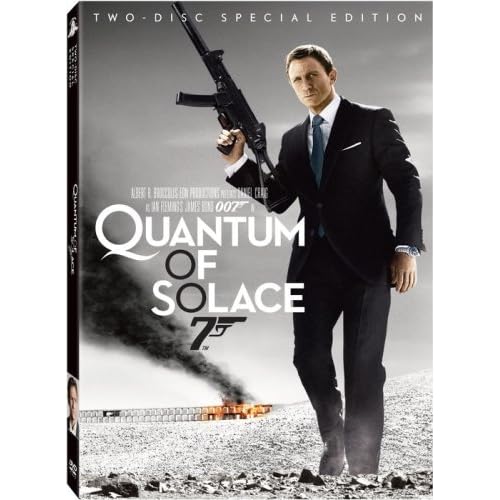
Last up are "Theatrical Teaser Trailer #1" (1:51, HD) and "Theatrical Trailer #2" (2:23, HD). Though a double-dip is inevitable, there's plenty to absorb on this first go-round.
 |
| Review gear: |
Panasonic Viera TC-P55VT30 55" Plasma 1080p 3D HDTV
Oppo BDP-93 Universal Network 3D Blu-ray Disc Player
Denon AVR2112CI Integrated Network A/V Surround Receiver
|
Pioneer SP-BS41-LR Bookshelf Speaker (2)
Pioneer SP-C21 Center Speaker
Pioneer SW-8 Subwoofer
|
|---|