

 RSS or
 Email.

Sponsored Links
Related Reviews
-
The Incredible Hulk (2008)


-
Hulk (2003)

-
Iron Man (2008)

-
Hulk Vs. (V) (2009)
-
X-Men: The Last Stand (2006)
-
Spider-Man 3 (2007)
-
Spider-Man 2 (2004)

-
Spider-Man (2002)
-
Elektra (2005)

-
Daredevil (2003)
-
Fantastic Four: Rise of the Silver Surfer (2007)
-
Fantastic Four (2005)
-
X-Men: First Class (2011)
-
X-Men: Days of Future Past (2014)
-
Deadpool (2016)
-
X-Men: Apocalypse (2016)
-
The Wolverine (2013)
-
Logan (2017)
Patrick Stewart
-
Chicken Little (2005)
-
Star Trek: Nemesis (2002)
-
Teenage Mutant Ninja Turtles: 25th Anniversary Collector's Edition (2009)
-
Hamlet (TV) (2009)
-
Gnomeo & Juliet (2011)
-
Ted (2012)

-
Star Trek: The Next Generation—Season One (1987)
-
Star Trek: The Next Generation—Season Two (1988)
-
Star Trek: The Next Generation—Season Three (1989)
-
Star Trek: The Next Generation—The Best of Both Worlds (1990)
-
Star Trek: The Next Generation—Redemption (1991)
-
Star Trek: The Next Generation—Season Four (1987)
-
Star Trek: The Next Generation—Season Six (1992)
-
Star Trek: The Next Generation—Chain of Command (1992)
Hugh Jackman
-
The Fountain (2006)
-
Happy Feet (2006)
-
Flushed Away (2006)
-
The Prestige (2006)
-
Van Helsing (2004)

-
Rise of the Guardians (2012)
-
Les Misérables (2012)
-
Chappie (2015)
Ian McKellen
-
The Da Vinci Code (2006)
-
Asylum (2005)
-
The Lord of the Rings: The Return of the King (2003)
-
The Lord of the Rings: The Two Towers (2002)
-
The Lord of the Rings: The Fellowship of the Ring (2001)
-
Gods and Monsters (1998)
-
Doctor Who: The Snowmen (2012)
-
The Hobbit: The Battle of the Five Armies (2014)
-
Mr. Holmes (2015)
-
Beauty and the Beast (2017)
-
All Is True (2018)
-
The Good Liar (2019)
Halle Berry
-
Perfect Stranger (2007)
-
Robots (2005)
-
Catwoman (2004)
-
Gothika (2003)
-
Die Another Day (2002)
-
Bulworth (1998)
-
Monster's Ball (2001)
-
New Year's Eve (2011)
-
Cloud Atlas (2012)
-
Sidney (2022)
Famke Janssen
-
The Ten (2007)
-
Hide and Seek (2005)
-
The Wackness (2008)
-
Taken 2 (2012)
-
The Blacklist: The Complete Third Season (2013)
Bryan Singer


X2 (X-Men 2)
(2003)

 Some say the world will end in fire,
Some say in ice.
From what I've tasted of desire
I hold with those who favor fire.
But if it had to perish twice,
I think I know enough of hate
To know that for destruction ice
Is also great
And would suffice.
--Robert Frost, "Fire and Ice," 1920.
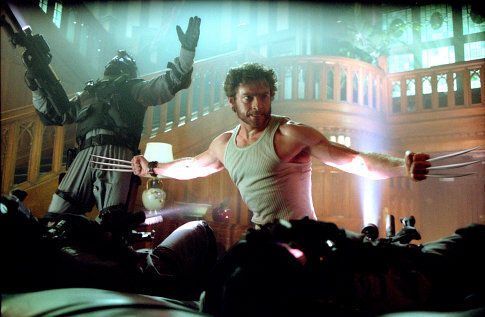
Frost's literal-figurative examination of human existence and apocalypse seems aptly, if oddly, fitted to the superhero epic X2, Bryan Singer's hotly anticipated sequel to 2000's X-Men. Like most superhero tales, X2 takes us to the brink of destruction so that heroes can "save the world." X2 also plays with opposed pairs, including the mutants "Iceman" and "Pyro." Perhaps most importantly, X2 advances Singer's metaphorical portrait of modern America as once more on a cusp of major social change; with this stress come fear, hatred, distrust, and violence. Indeed, X2 runs hot and cold, but mostly satisfies with its "upgraded" science-fiction razzle-dazzle.
X2 picks up where the first film left off, though one needn't have seen the first film to pick up the plot. According to X-Men lore, elaborated on in hundreds of Marvel comics since 1963, the human species has taken a genetic leap to the next evolutionary level. The minority wave of humans who have evolved, the mutants, face a McCarthy-esque climate. The fearful and resentful are represented in the first film by Bruce Davison's Senator Robert Kelly (who appears in a different "form" here) and, in X2, by Brian Cox's Gen. William Stryker, a more serious variation on Gen. Jack D. Ripper.
Stryker, for reasons which turn out to be more personal than political, wants to wipe out all of the mutants. From the halls of power, Stryker arranges for a surgical strike on Xavier's School for Gifted Youngsters, the euphemistically named boarding school for mutants run by the powerful psychic Professor X (Patrick Stewart). There, in relative safety, live mutants old and young, among them X's psychic protégé Dr. Jean Grey (Famke Janssen), her heat-ray-eyed boyfriend Cyclops (James Marsden), and weather-controlling Storm (Halle Berry). The younger crew includes superpower-conduit Rogue (Anna Paquin), Rogue's boyfriend Iceman--a.k.a. Bobby Drake (Shawn Ashmore)--and Pyro, now played by Aaron Stanford (Tadpole).
The star of the show, as before, is Hugh Jackman's grumpy and mysterious Wolverine (real name: Logan), whose remarkable healing powers allow him to endure an adamantium skeleton which spontaneously shoots lengthy claws from his knuckles (look, I told you it was a mutant superhero movie). At some point, some sinister scientist implanted this skeleton in Logan's body without his consent, and when the film begins, Logan is pursuing the truth he knows is out there.
Further complicating matters is a morally suspect shadow group of mutants, led by Professor X's friend-gone-bad Magneto (Sir Ian McKellen). It's not giving much away to let on that Magneto escapes his plastic prison (erected to hold the metal-controlling mutant in the first film) and raises a ruckus. X2 allows Magneto and his crew--including Rebecca Romijn-Stamos's Mystique--to play both sides of the fence--hence the advertising subtitle "X-Men United"--for the common cause of saving all mutants from an ignominious demise. Stryker's plan is to harness the power of Professor X's Cerebro mind machine to implode every dirty mutant on the globe, inverting Magneto's "kill all humans" goal from the first film.
From the winking "X" in the opening 20th Century Fox logo, X2 is a witty and eye-popping adventure with generous portions of action. Singer never tops the set piece which opens the film, an elaborate White House break-in by the ambiguous, blue, tattooed, long-tailed, German-accented, teleporting mutant Nightcrawler (Alan Cumming), but not for lack of trying with plenty of special effects-laden battles. Though the supersized X2 is an even more plot-driven installment than X-Men's relatively lean origin story, Singer and an expanded team of screenwriters even find room for bits of subtle humor, like Mystique and Magneto cattily commiserating--on an airplane full of uneasy mutants--like kids at the back of a classroom.
Such moments also feed into the unavoidable gay subtext of the film. Though the overt romantic heat continues to be heterosexual, Singer continues to play the mutant conflict with humans as an allegory for the gay experience. X2 continues the first film's skewering of a conservative political mindset positioned against gay civil rights. Professor X tells Stryker, at one point, "Mutation is not a disease," while in an extended sequence, Bobby Drake must come out to his parents (his overcompensating mother asks, "So when did you first know you were a--?" and "Have you tried...not being a mutant?"). Singer, who is gay, also prominently casts openly gay actors Cumming and McKellen, whose Magneto may well have been more than friends with Professor X in the past.
While certainly the sort of must-see summer-movie entertainment which delivers one's money's worth of spectacle, sass, and surprise, X2 has its failings. After galloping out of the gate, X2 drags in its final stretches and isn't always as focused or coherent as the first film (ground rules are never adequately established for mutant mind-control, for instance). Though the crack cast is mostly delightful, Cumming overplays Nightcrawler, and Marsden drops the ball in a climactic bit of hideous overacting. Still, with dozens of interesting characters to service, X2 does its clever best to deliver a satisfying episode, and it's no small measure of the sequel's success that it leaves one longing to see what happens in the next exciting chapter.


 Permalink
 |
|
 |
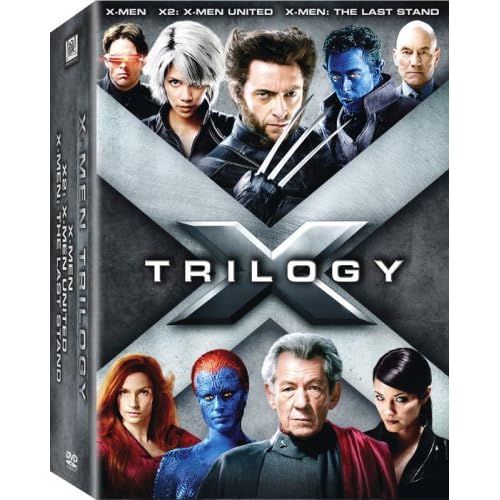
Fox knows a lucrative franchise when it sees one, and it's given X-Men the gold-standard treatment on Blu-ray. Packaged in an X-Men Trilogy set, X-Men, X2, and X-Men: The Last Stand look their best and come with all previously issued DVD extras.
X2 comes in a three-disc set that includes a Digital Copy on the third disc. Image quality is outstanding: nitpickers may notice a hint of noise in some backgrounds and slightly imperfect shadow detail, but realy there's very little about which to complain: rather enjoy the vibrantly reproduced color, fine detail, and smooth presentation of fast-paced action. This is just the sort of movie that benefits from pumped-up hi-def sound, and the lossless DTS-HD 5.1 Master Audio mix does not disappoint, offering immersive directionality and potent effects.
Disc One includes the film and two commentaries: a commentary with Bryan Singer and director of photography Tom Sigel, and a commentary with producers Lauren Shuler-Donner and Ralph Winter and writers Michael Dougherty & Dan Harris (with a few comments from writer David Hayter, who wrote an earlier draft). Also on Disc One are two Teaser Trailers and the Theatrical Trailer in HD.
Disc Two offer's the wolverine's share of bonus features. The "History of the X-Men" comprises "The Secret Origin of X-Men" (15:26, SD), which nicely recounts Stan Lee's creation of the comic, and its development with various other talents in the Marvel stable (some of whom are interviewed). "Nightcrawler Reborn" (7:37, SD) explores the character in his comic-book origins and his introduction into the film franchise.
Pre-Production begins with a multi-angle look at the opening Nightcrawler sequence. The four angles offer animatics, work-in-progress footage, and the final version. "Evolution in the Details: Designing X2" (18:01, SD) allows production designer Guy Dyas to give us a tour of the sets, and we see other designs in concept art. "United: Colors of X2" (8:57, SD) likewise gives costume designer Louise Mingenbach a chance to talk about her work; we also get a glimpse of costume test footage.
The Production suite first breaks down the "Wolverine/Deathstrike Fight Rehearsal" (1:24, SD) by various stages of development including rehearsal footage, walkthrough footage, and the final version. "The Second Uncanny Issue of X-Men: Making X2" (59:27, SD) is an in-depth making-of incorporating extensive interviews with cast, crew, and Singer (and ending with an amusing outtake).
"Introducing the Incredible Nightcrawler!" (9:49, SD) focuses on Alan Cumming getting the role and his process of becoming the character. "Nightcrawler Time-Lapse" (2:27, SD) mimics the Wolverine/Deathstrike sequence, but with more animatics. "FX2: Visual Effects" (24:58, SD) allows CG supervisor Michael Fink to explain key sequences, which are then presented in breakdowns.
Post-Production includes "Requiem for Mutants: The Score of X2" (11:39, SD) with composer/editor John Ottman explaining his process. "X2 Webcast Highlights" (17:01) features cast Q&As from the global public appearance tour.
Last up are eleven "Deleted Scenes" (11:58, SD), six Galleries totaling about 650 stills, a Teaser Trailer, and two Trailers (two of which are in HD). Fans will love this Blu-ray edition of the X-Men Trilogy, and by the evidence of X-Men Origins: Wolverine, the demand for these characters has little waned.
 |
| Review gear: |
Panasonic Viera TC-P55VT30 55" Plasma 1080p 3D HDTV
Oppo BDP-93 Universal Network 3D Blu-ray Disc Player
Denon AVR2112CI Integrated Network A/V Surround Receiver
|
Pioneer SP-BS41-LR Bookshelf Speaker (2)
Pioneer SP-C21 Center Speaker
Pioneer SW-8 Subwoofer
|
|---|