

 RSS or
 Email.

Sponsored Links
Related Reviews
Anna Faris
-
Scary Movie 4 (2006)

-
Brokeback Mountain (2005)


-
Just Friends (2005)

-
Lost in Translation (2003)

-
Observe and Report (2009)

-
What's Your Number? (2011)
-
The Dictator (2012)
Emma Stone
-
The Rocker (2008)
-
The Help (2011)
-
The Amazing Spider-Man (2012)

-
Gangster Squad (2013)
-
The Croods (2013)
-
The Amazing Spider-Man 2 (2014)
-
Magic in the Moonlight (2014)
-
Birdman (2014)
Kat Dennings


The House Bunny
(2008)

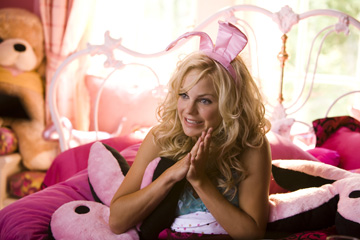 The target audience for the new comedy The House Bunny will have no idea who Judy Holliday is, but leading lady Anna Faris delivers a brilliant performance in the Holliday mode. The "dumb blonde" is less politically correct than it used to be in Holliday's '50s heyday, but Faris' newfangled version—a Playboy bunny turned sorority house mother—becomes the blunt instrument in a mild exploration of finding a balance between looking good, feeling good, and getting smart.
In the film-opening narration, Shelley Darlingson (Faris) explains that she grew up an orphan, but "now I live in the Playboy Mansion. This is where I want to live happily ever after." On the occasion of her 27th birthday ("59 in Bunny years," she's told), Shelley finds herself booted from her dreamland. Though Hugh Hefner (who plays himself) is depicted as oblivious to her misfortune, it's clear from getting an eyeful that if age isn't a criterion for eviction, faded beauty certainly is. As Shelley puts it, "Feeling good on the inside is all about looking good on the outside."
Walking the streets in a fretful state of shock, Shelley spies a house that looks an awful lot like her former home. It turns out to be the top sorority at the local university, but her offer of house motherhood is roundly rejected by the young and old snobs within. Only slightly daunted, Shelley worms her way into the rundown Zeta Alpha Zeta House, which is about to lose its charter (the monomyth of "Greek" movies). The denizens of ZAZ (a nod to the comedy writing-directing team of Zucker-Abrahams-Zucker?) are a pathetic lot, at pains to attract either pledges or boys. One dresses like a lumberjack with pigtails, one is too shy even to speak, one (Rumer Willis) wears a full-torso spinal brace that turns out to be more of a security blanket than a medical necessity. Goth girl Kat Dennings (star of the upcoming Nick and Norah's Infinite Playlist) and sweet nerd Emma Stone (Superbad) stand out amongst the sisters.
Though the characters are clichés to a one, Karen McCullah Lutz & Kirsten Smith obviously have in mind to address the low-self-esteem issues perpetrated by the very likes of Shelley under the leadership of Hef. And they do pay lip service to the issues, but the comedy is diffused when it should be barbed. With Hef on board, the punches are pulled, and the most subversive comedic idea—that the best self-esteem boost these girls could get might come from a Playboy bunny—quickly reveals itself as pure formula. Beverly D'Angelo plays the cool sorority's cold house mother Mrs. Hagstrom, and Christopher McDonald plays the dean whose gavel will determine Zeta Alpha Zeta's fate (his consideration of one last-ditch attempt is one of the film's funniest moments).
Despite the film's overall limpness (especially in a halfhearted romantic subplot between Faris and Colin Hanks), The House Bunny is almost worth seeing just for Faris' spot-on work. From her strange method of remembering people's names to her earnest desire to be excellent in all things, Shelley becomes an endearing character in Faris' nonjudgmental hands. The fairy tale soro-comedy she's stuck in is no joke, but Faris should be able to parlay it into bigger and better things.


 Permalink
 |
|
 |
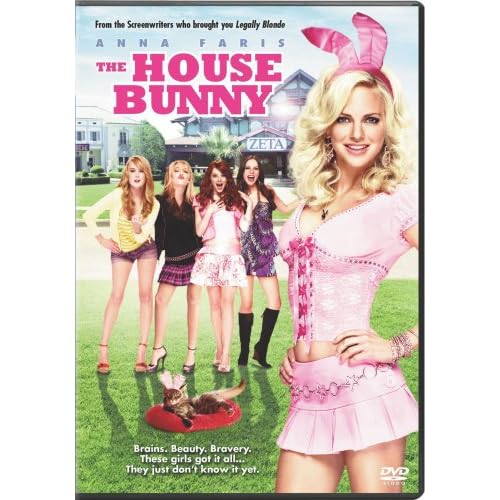
Sony lets girls go wild on its new special edition of The House Bunny, which is bustin' out all over with extras (sorry, sorry...). The A/V transfer is exceptional, with brilliant color and an all-around crisp and clean image; the Dolby TrueHD 5.1 Surround mix is more than up to the task of fully recreating the theatrical experience of The House Bunny, with a nicely balanced use of surrounds.
The extras kick off with ten "Deleted Scenes" (12:01 with "Play All" option, SD) and move on to no less than twelve Featurettes (53:13 with "Play All" option, HD): "Anna Faris: House Mom," "The Girls of Zeta," "The Girls Upstairs," "Colin Hanks: Mr. Nice Guy," "From Song to Set: Katharine McPhee," "From Tour Bus to Trailer: Tyson Ritter," "Look Who Dropped By," "House Bunny Style," "Zetas Transformed," "Getting Ready for a Party," "Calendar Girls," and "House Bunny Memories."
It's not hard to figure out the topics covered, by looking at the titles: the focus is not on filmmaking (director Fred Wolf is glimpsed but never interviewed) but on the stars, glamour, and celebrity. It's all well and good, I suppose, though a bit ironic: among the many participants are Faris, producer Heather Perry, Hanks, Emma Stone, Kat Dennings, Dana Goodman, McPhee, Rumer Willis, Kimberly Makkouk, producer Allen Covert, Kiely Williams, Holly Madison, Bridget Marquardt, Kendra Wilkinson, Ritter, Matt Leinart, Sean Salisbury, Nick Swardson, Dan Patrick, costume designer Mona May, and Sarah Wright.
"I Know What Boys Like" comes with an "Introduction" with McPhee and song producer Kenna (:30, HD), followed by the "Music Video" (2:21, HD). The disc also includes Previews and the BD Live hookup for more exclusive content online at Sony's website. It's nice to see so much of the bonus content presented in HD; surely fans of The House Bunny will thrill to the hour of behind-the-scenes footage.
 |
| Review gear: |
Panasonic Viera TC-P55VT30 55" Plasma 1080p 3D HDTV
Oppo BDP-93 Universal Network 3D Blu-ray Disc Player
Denon AVR2112CI Integrated Network A/V Surround Receiver
|
Pioneer SP-BS41-LR Bookshelf Speaker (2)
Pioneer SP-C21 Center Speaker
Pioneer SW-8 Subwoofer
|
|---|