

 RSS or
 Email.

Sponsored Links
Related Reviews
Heath Ledger
-
Casanova (2005)

-
The Brothers Grimm (2005)
-
Lords of Dogtown (2005)

-
Ned Kelly (2004)
-
Monster's Ball (2001)

-
A Knight's Tale (2001)
-
The Dark Knight (2008)


-
The Imaginarium of Doctor Parnassus (2009)
Jake Gyllenhaal
-
Zodiac (2007)
-
The Day After Tomorrow (2004)
-
Prince of Persia: The Sands of Time (2010)

-
Source Code (2011)
-
Proof (2005)
-
End of Watch (2012)
-
Demolition (2015)

-
Nocturnal Animals (2016)
-
Stronger (2017)
-
Wildlife (2018)
-
Spider-Man: Far From Home (2019)
Linda Cardellini
-
Scooby Doo 2: Monsters Unleashed (2004)

-
Scooby Doo (2002)
-
Home (2015)
-
Welcome to Me (2015)
-
Freaks and Geeks: The Complete Series (1999)
-
Daddy's Home Two (2017)
-
Green Book (2018)
Anna Faris
-
Scary Movie 4 (2006)
-
Just Friends (2005)
-
Lost in Translation (2003)
-
The House Bunny (2008)
-
Observe and Report (2009)
-
What's Your Number? (2011)
-
The Dictator (2012)
Anne Hathaway
-
Becoming Jane (2007)
-
The Devil Wears Prada (2006)
-
Hoodwinked (2005)
-
The Princess Diaries 2: Royal Engagement (2004)
-
Ella Enchanted (2004)
-
Get Smart (2008)
-
Bride Wars (2009)
-
Alice in Wonderland (2010)
-
Valentine's Day (2010)
-
Rio (2011)
-
One Day (2011)
-
The Dark Knight Rises (2012)
-
Les Misérables (2012)
-
Rio 2 (2014)
-
Interstellar (2014)
-
The Intern (2015)
-
Colossal (2016)
-
Ocean's Eight (2018)
Ang Lee


Brokeback Mountain
(2005)

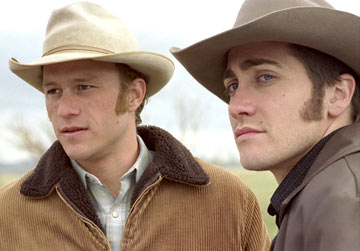 The romance genre has always depended on cruel obstacles. Romeo and Juliet, Wuthering Heights, Casablanca. But Hollywood has pretty much lost its imagination when it comes to romance, settling for moribund disease-of-the-week weepies and unfunny romantic "comedies." With Brokeback Mountain, Ang Lee paints an epic romance that's long overdue: one between two men. As in the great stories to proceed it, Brokeback Mountain's heroes must overcome a hostile society to share their love, and it ain't gonna be easy.
The story—adapted by Larry McMurtry and Diana Ossana from E. Annie Proulx's much-heralded short story—is deceptively simple: two ranchhands in 1963 Wyoming find each other when they both land a sheepherding job in the remote wild of Brokeback Mountain. Ennis Del Mar (Heath Ledger) is taciturn and gruff; Jack Twist (Jake Gyllenhaal), formerly of the rodeo circuit, bursts with loose-cannon energy. With all the time in the world, the two men begin to share their experiences: Ennis discovers he doesn't mind listening to Jack, or even talking to him.
One bitterly cold night, the men wind up huddled in the same small tent, where they wordlessly grapple each other in an act of fierce passion. What Ennis hastens to call a "one-shot thing" becomes a season of love, but before long the job ends, and the men awkwardly go their separate ways. In frustration, both men try paths of least resistance—repression and marriage—but the flame won't go out. Over the decades, Ennis and Jack meet for "fishing trips" that allow trysts and dead-end considerations of how to improve their lot in life: Jack suggests that they get a ranch of their own; Ennis has good reason to doubt that two men can make a life together in America's "heartland."
Lee masterfully keeps his viewers hanging on every frame with closely observed storytelling and life-like rhythms. McMurtry and Ossana's emotionally detailed script makes a great starting point, and Lee powerfully uses Western conventions to visualize the unconventional love story. Big-sky scenery and the iconic imagery of rough-riding, overcast "Marlboro Men" set the stage for Lee's distinctive brand of symbolist drama (is it coincidental that the film begins in Signal, Wyoming?).
While attending to realism, Lee encodes each scene with emotional and thematic subtext. Without a wasted frame, Lee observes the flowering of the relationship between the two men. In one representative shot, Lee places Jack in the foreground, as an unclothed Ennis bathes in the background. Here, it's about what doesn't happen: Jack never turns around (though Lee knows that we know that Jack would like to look). When Jack eventually makes a move on Ennis, we know that it's not a whim—it's an act of courage with an emotional cost. As for symbols, the lonely idyll of Brokeback Mountain is but one of many. Picnicking with his wife (Michelle Williams) and kids, Ennis takes out his frustration on two loudmouth, pussy-seeking jerks. The occasion? Independence Day.
The acting is notable all around. Williams and Anne Hathaway are revelatory as the scorned wives, the former stunned into a tightly-wound repression of her own and the latter gradually soured by her functional but love-deficient marriage. Ennis has married sideways and Jack up—Williams and Hathaway perfectly adapt to their respective milieus (credit Judy Becker for the expert production design). As the homophobic boss-man, Randy Quaid reminds us that he's capable of a delicate performance, and Kate Mara shines in the small but key role of Ennis' grown daughter.
Naturally, Brokeback Mountain belongs to two men. Ledger bottles a wholehearted maelstrom: when he uncaps himself, the Oscars get their clip, but he's equally affecting in the scenes that betray fissures in his surface. Gyllenhaal masters Jack's set of frustrations: he's already been and gone from Ennis's place of self-loathing. With skill and commitment, Gyllenhaal expresses Jack's love and anger, over injustice and his partner's failure of boldness.
The story resolves with a final wave of elegant symbolism and tender feeling that leaves the audience to consider the wages of individual and institutionalized responsibility for human oppression. In a time when gay marriage has become a pressing point, Lee takes a long, hard look at the human element of the last, as-yet-untamed frontier of civil rights. Proulx couldn't know it when she wrote her 1997 story, but Wyoming would be home, one year later, to the lightning-rod cautionary tale of Matthew Shepard, the gay youth beaten, strung up, and left to die by two conflicted young men.
By using classical romantic convention, Lee ironically breaks new ground. Though ostensibly an independent film (coming as it does from Universal's "specialty division" Focus Features), Brokeback Mountain walks and talks like a Hollywood production despite subject matter many will find subversive. Poised on the mainstream with its rising-star leads, first-class director, and Oscar prospects, Brokeback Mountain will play in Peoria, but will it play? One day the point will be moot, but Lee's universal story of elusive love will remain.
[For Groucho's interview with director Ang Lee, click here.]


 Permalink
 |
|
 |
In its Blu-ray debut from Universal, Brokeback Mountain retains all of the bonus features from the 2007 Two-Disc Collector's Edition DVD and gives the A/V transfer a notable upgrade. Despite a bit of edge enhancement, this is a solid and accurate rendering of the film's grain and color scheme, providing especially strong results in the film's many outdoor scenes of western vistas. Sound is a definitive DTS-HD Master Audio 5.1 mix, preserving every nuance of the original theatrical tracks.
First up among the extras is "A Groundbreaking Success" (17:13, SD), in which producer James Schamus, journalists Matt Zoller Seitz and Alonso Duralde, Heath Ledger, film critic B. Ruby Rich, writer/producer Diana Ossana, Jake Gyllenhaal, executive producer Michael Costigan, director Ang Lee, and Variety editor-in-chief Peter Bart recall and consider the reaction from the media during pre-production, production and post-production, as well as the film's reception by audiences.
"Music from the Mountain" (11:17, SD) discusses the score and songs while giving us glimpses of scoring and recording sessions, including Willie Nelson's. Participants include composer Gustavo Santaolalla, music supervisor Kathy Nelson, Lee, Schamus, Costigan, singer/songwriters Mary McBride, Rufus Wainwright, Teddy Thompson, and Steve Earle.
"Impressions from the Film" (2:33, SD) is a montage of pre-production concept art and production stills set to Santaolalla's score.
"On Being a Cowboy" (5:43, SD) explains how (and how well) actors took to their wrangling and rodeo duties, with comments from stunt coordinator Kirk Jarrett, animal wrangler TJ Bews, Ossana, Ledger, wrangler Don Gillespie, Gyllenhaal, Lee, and Anne Hathaway.
"Directing from the Heart: Ang Lee" (7:27, SD) focuses on the work ethic of Lee, though it's a fluffy piece that obviously doesn't acknowledge Lee's notoriously cold mien with actors. Lee, Ledger, Randy Quaid, Hathaway, Anna Faris, Linda Cardellini, Gyllenhaal, Schamus, Ossana, Costigan, cinematographer Rodrigo Prieto, and costume designer Marit Allen smile for the camera.
"From Script to Screen: Interviews with Larry McMurtry and Diana Ossana" (10:53, SD) examines the adaptation process with screenwriters McMurtry and Ossana. Also lending their thoughts are Schamus, Quaid, Lee, Hathaway, Cardellini, Ledger, Gyllenhaal, and Costigan.
A Logo Movie Special redubbed "Sharing the Story: The Making of Brokeback Mountain" (20:48, SD) rounds out the disc, and does a peppy job of providing an overview of the film's production. Gyllenhaal, Ledger, Michelle Williams, Lee, Hathaway, Schamus, Ossana and McMurtry, Cardellini, production designer Judy Becker, and Santaolalla sit for interviews amid clips and behind-the-scenes footage.
Lastly, the disc includes the usual BD-Live hookup for sharing My Scenes and looking up added content like trailers.
 |
| Review gear: |
Panasonic Viera TC-P55VT30 55" Plasma 1080p 3D HDTV
Oppo BDP-93 Universal Network 3D Blu-ray Disc Player
Denon AVR2112CI Integrated Network A/V Surround Receiver
|
Pioneer SP-BS41-LR Bookshelf Speaker (2)
Pioneer SP-C21 Center Speaker
Pioneer SW-8 Subwoofer
|
|---|